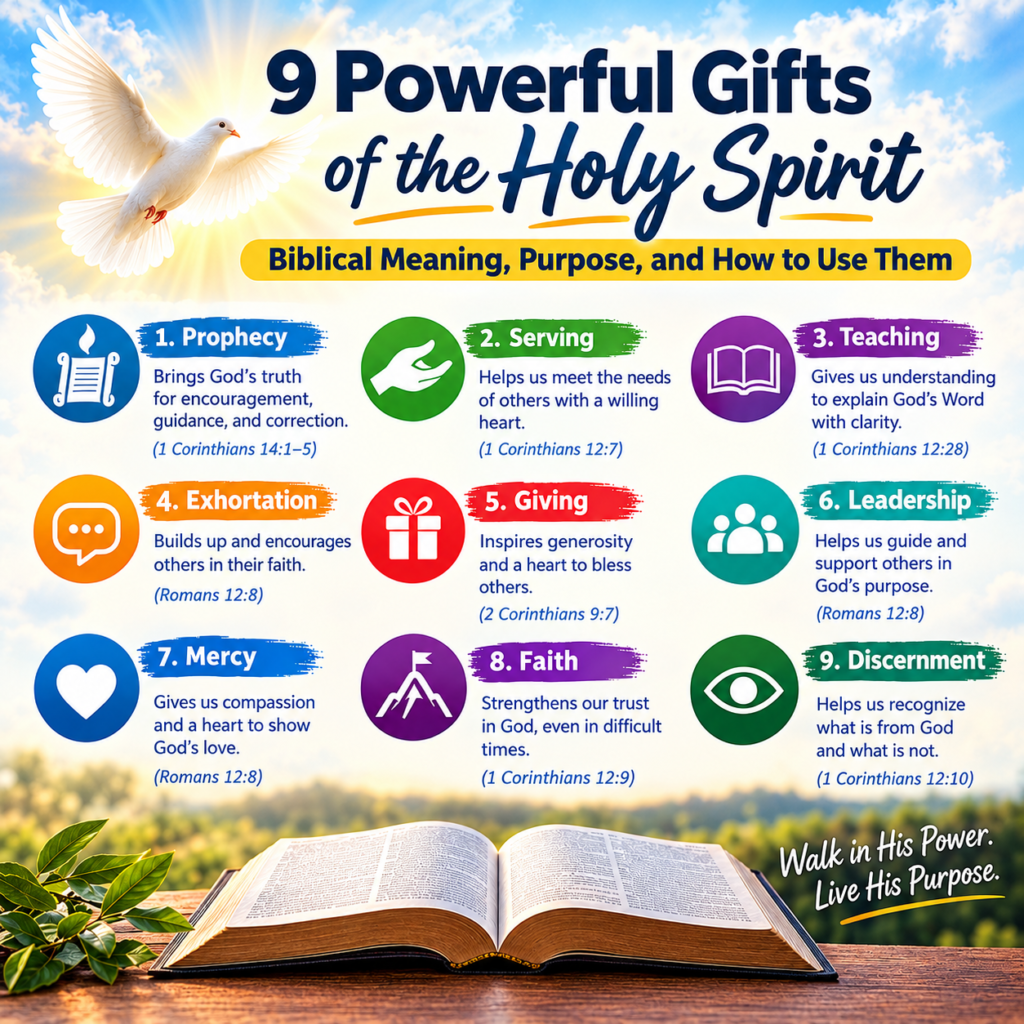
The Christian life involves more than attending church, reading Scripture, or following religious traditions. It also involves spiritual growth, serving others, and developing a deeper relationship with God. One important part of this journey is understanding the gifts of the Holy Spirit and how they are described in the Bible.
These gifts are special abilities given by the Holy Spirit to believers for the benefit of the church and the wider community. They help Christians encourage others, share wisdom, demonstrate faith, serve with compassion, and communicate God’s message.
The Bible discusses spiritual gifts in several passages, especially 1 Corinthians 12, Romans 12, and Ephesians 4. Each passage highlights different ways believers can contribute to the body of Christ.
This guide explores the nine gifts described in 1 Corinthians 12:8–10, explains their biblical meaning, addresses common misunderstandings, and offers practical ways to understand their purpose in everyday Christian life.
What Are the Gifts of the Holy Spirit?
The gifts of the Holy Spirit are abilities or forms of spiritual empowerment that God gives to believers to serve others and strengthen the church. According to Christian teaching, these gifts are not simply personal talents or achievements. They are understood as expressions of God’s grace working through people.
In 1 Corinthians 12:7, Paul explains that the manifestation of the Spirit is given for the common good. This principle provides an important foundation for understanding spiritual gifts: they are intended to benefit others rather than promote personal status.
For example, a Christian may offer wise guidance to someone facing a difficult decision. Another may demonstrate extraordinary faith during a crisis, while someone else may encourage a struggling congregation through a message of hope.
Different Christian traditions interpret certain gifts differently, particularly those involving miracles, prophecy, and speaking in tongues. However, many agree that spiritual gifts should be exercised with humility, love, and concern for others.
Why Did God Give Spiritual Gifts?
The New Testament presents several purposes for spiritual gifts:
- Strengthening the church: Gifts help believers build a supportive and spiritually mature community.
- Serving others: They encourage Christians to use their abilities for the benefit of people around them.
- Sharing truth: Certain gifts help communicate, explain, or discern spiritual matters.
- Encouraging faith: They can bring comfort, hope, and reassurance during difficult circumstances.
- Supporting Christian ministry: They help believers participate in the work of the church according to their abilities and calling.
First Corinthians 12:12–27 compares the church to a body with many parts. Each part has a different function, but every part matters. This image illustrates why Christians should value different gifts rather than assume that only the most visible ministries are important.
The 9 Gifts of the Holy Spirit Explained
First Corinthians 12:8–10 identifies nine manifestations of the Spirit. They are commonly grouped into gifts involving revelation, power, and inspired speech, although these groupings are teaching frameworks rather than categories explicitly listed by Paul.
1. The Word of Wisdom
The word of wisdom is commonly understood as a Spirit-given insight that helps someone apply God’s truth to a particular situation. It involves more than collecting information or offering ordinary advice.
A person demonstrating wisdom may help others recognize a responsible path forward when emotions, uncertainty, or conflicting opinions make a decision difficult.
For example, two church members may disagree about a ministry project. Instead of encouraging either side to win the argument, a wise leader may help both parties identify their shared purpose and find a fair solution.
Biblical wisdom also involves humility, patience, and sound judgment. James 3:17 describes wisdom from above as pure, peaceable, gentle, and full of mercy.
Practical application: Christians can seek wisdom through prayer, Scripture, thoughtful reflection, and advice from trustworthy people. A claim to spiritual wisdom should never become an excuse to manipulate others or avoid accountability.
2. The Word of Knowledge
The word of knowledge is often understood as Spirit-given knowledge or insight concerning a particular matter. Christian interpretations differ about exactly how this gift operates.
Some understand it as receiving insight about information that a person could not ordinarily know. Others emphasize a Spirit-enabled understanding of truth that helps a community recognize and respond to a situation.
For example, a church member might recognize that a family needs practical support even when the family has not openly requested help. The response could involve offering meals, arranging assistance, or providing emotional support.
This example illustrates compassionate awareness, although it does not establish that every act of noticing another person’s needs is a supernatural manifestation.
Practical application: Christians can develop a habit of listening carefully, paying attention to others, and responding sensitively. Any claimed revelation about another person should be handled responsibly, without invading privacy or making unsupported accusations.
3. The Gift of Faith
The gift of faith in 1 Corinthians 12 refers to a particular manifestation of faith given by the Spirit. It is often distinguished from the ordinary faith through which Christians trust God.
This gift is commonly associated with unusual confidence in God’s power, promises, or purposes during challenging circumstances.
Consider a community facing a serious financial difficulty. A believer with strong, Spirit-inspired confidence may encourage the group to remain hopeful, continue serving responsibly, and trust God while taking practical steps to address the problem.
The gift does not mean that believers will never experience fear or uncertainty. Nor does it guarantee that every desired outcome will occur.
Practical application: Christians can strengthen their everyday faith through prayer, studying biblical promises in context, remembering past experiences of God’s faithfulness, and taking responsible action even when the future remains uncertain.
4. Gifts of Healing
The gifts of healing refer to the healing manifestations mentioned in 1 Corinthians 12:9. The plural wording in the passage has prompted different interpretations concerning the variety of healings or circumstances involved.
Many Christians believe God can bring physical, emotional, or other forms of healing through prayer and ministry. Others place particular emphasis on the miraculous healings described in the New Testament.
For example, a congregation may pray for someone experiencing illness while offering transportation, companionship, meals, and support for the person’s family.
Prayer can be an important source of comfort and spiritual strength. However, it should not replace appropriate medical assessment or treatment.
Practical application: Christians can pray compassionately for those who are ill, respect their choices, protect their privacy, and support evidence-based medical care. No one should be blamed for lacking faith because a recovery does not occur.
5. The Working of Miracles
The working of miracles describes extraordinary acts of divine power. In the biblical account, miracles serve purposes such as demonstrating God’s power, meeting urgent needs, and supporting God’s work.
The Bible includes accounts of Jesus healing the sick, feeding hungry crowds, and exercising authority over natural forces. The apostles also performed extraordinary signs in the early church.
A modern Christian community may understand an unexpected event as a miracle. Such interpretations are matters of faith and should be considered carefully rather than treated as scientifically established explanations without evidence.
The purpose of discussing miracles is not to encourage sensational claims. It is to recognize that many Christians believe God can act beyond ordinary human expectations.
Practical application: Christians can remain open to God’s power while avoiding exaggerated promises, financial exploitation, or claims that cannot be responsibly supported. Genuine ministry should demonstrate compassion and humility rather than pressure people to believe a particular story.
6. Prophecy
Prophecy is one of the most discussed gifts in Christian communities. In 1 Corinthians 12, it appears among the manifestations of the Spirit, while 1 Corinthians 14 emphasizes its role in strengthening, encouraging, and comforting believers.
Christians differ over whether contemporary prophecy involves direct messages from God, Spirit-guided preaching, or other forms of inspired communication.
For example, a church leader might deliver a message that encourages people to pursue reconciliation, care for vulnerable neighbors, or remain faithful during hardship. Such teaching may be described as prophetic in some traditions.
However, a personal prediction or spiritual claim should never be accepted automatically simply because someone says it comes from God.
First Corinthians 14:29 instructs the community to weigh prophetic messages. This principle highlights the importance of discernment and accountability.
Practical application: Christians can evaluate spiritual messages in light of Scripture, Christian character, wise counsel, and their potential effects on others. No prophetic claim should be used to control another person’s relationships, finances, medical decisions, or personal freedom.
7. Discerning of Spirits
Discerning of spirits is commonly understood as the ability to distinguish the spiritual character or source of a message, influence, or manifestation.
In the early Christian community, this gift would have helped believers evaluate competing teachings and spiritual claims. It remains relevant to discussions about truth, deception, and responsible spiritual leadership.
For example, a person may notice that a religious speaker uses fear, shame, or promises of special status to control an audience. Careful discernment can encourage the community to examine the teaching and its consequences.
Nevertheless, discernment is not permission to label people as evil based on suspicion, personality differences, or disagreement.
Practical application: Christians can examine teachings carefully, compare them with Scripture, consider the evidence, and seek counsel from mature believers. Healthy discernment combines spiritual sensitivity with fairness, patience, and sound judgment.
8. Different Kinds of Tongues
The gift of tongues involves speaking in tongues, as described in 1 Corinthians 12:10. Christian traditions disagree about whether this gift primarily involves speaking in unlearned human languages, spiritual speech, or both in different biblical contexts.
Acts 2 describes people hearing the disciples speak in languages they could understand. First Corinthians 14 also discusses tongues in congregational worship and emphasizes the importance of interpretation when necessary for the gathered church.
These passages show that tongues should be understood within their biblical context rather than reduced to one universal explanation accepted by every Christian tradition.
For example, some Pentecostal and charismatic churches include speaking in tongues as part of their worship practices. Other Christian communities interpret the gift differently or believe that it was especially associated with the early church.
Practical application: Christians can approach this subject with humility and respect. No believer should be mocked, pressured to imitate another person’s experience, or automatically considered spiritually inferior because they do not speak in tongues.
9. Interpretation of Tongues
The interpretation of tongues is the gift associated with communicating the meaning of a message spoken in tongues so that the congregation can understand it.
In 1 Corinthians 14, Paul emphasizes that understandable communication is important in public worship because it allows the church to be strengthened.
For example, in a congregation where someone speaks in tongues during a gathering, an interpretation may be offered so that others can understand the message and consider its significance.
Paul’s teaching does not encourage disorderly worship or the assumption that every unusual utterance must be accepted without evaluation.
Practical application: Churches can establish clear, respectful practices for public worship. Messages should be handled with care, interpreted when appropriate, and evaluated according to the principles of Scripture and the well-being of the congregation.
How Are the Gifts of the Holy Spirit Different From the Fruit of the Spirit?
The gifts of the Holy Spirit and the fruit of the Spirit are related Christian teachings, but they describe different aspects of spiritual life.
The gifts are forms of spiritual empowerment for service and the strengthening of the church. The fruit describes qualities of Christian character developed through life in the Spirit.
Galatians 5:22–23 identifies the fruit of the Spirit as love, joy, peace, patience, kindness, goodness, faithfulness, gentleness, and self-control.
The distinction matters because a person may have a visible ministry role without consistently demonstrating mature Christian character. The New Testament warns against separating spiritual activity from love.
First Corinthians 13, placed between Paul’s discussions of spiritual gifts in chapters 12 and 14, makes this point especially clear. Even remarkable spiritual abilities are meaningless without love.
A simple comparison helps explain the difference:
- Gifts: How a believer may be equipped to serve others.
- Fruit: The qualities that should increasingly shape the believer’s character.
- Purpose of both: A life that reflects God’s love and contributes to the good of others.
For example, someone may be gifted at teaching but still need to grow in patience. Another person may be known for kindness and faithfulness while serving quietly without a prominent ministry role.
Both can contribute meaningfully to the Christian community.
How Can Christians Discover and Develop Their Spiritual Gifts?
Understanding the gifts of the Holy Spirit begins with prayer, learning, service, and honest reflection. The Bible does not present spiritual growth as a competition in which believers must prove that they possess extraordinary abilities.
The following steps can help Christians explore their gifts responsibly.
1. Study the Biblical Passages
Begin with 1 Corinthians 12–14, Romans 12:3–8, and Ephesians 4:11–16. These passages discuss spiritual gifts from different perspectives.
Reading the surrounding chapters helps prevent isolated verses from being interpreted without context.
2. Pray for Guidance
Prayer gives believers an opportunity to seek God’s direction, examine their motives, and become more willing to serve others.
Rather than demanding a particular gift, Christians can ask for wisdom, humility, courage, and opportunities to help people.
3. Begin Serving Others
Practical service can reveal where a person contributes most effectively. Teaching a small group, visiting someone who feels lonely, helping organize community support, or encouraging a discouraged friend can all provide opportunities for growth.
Not every act of service is evidence of a supernatural gift. However, consistent service can help a believer recognize strengths, responsibilities, and areas for development.
4. Seek Mature and Honest Feedback
Trusted Christian mentors and church leaders may help identify patterns in a person’s service. They can also provide constructive feedback about areas that require improvement.
Healthy guidance encourages personal responsibility rather than making someone dependent on another person’s spiritual authority.
5. Evaluate the Results With Humility
Spiritual gifts should contribute to the good of others. Christians can reflect on whether their service promotes encouragement, understanding, unity, and responsible care.
A gift should not become a reason to seek admiration or claim superiority over other believers.
Common Misconceptions About the Gifts of the Holy Spirit
Several misunderstandings can prevent Christians from approaching spiritual gifts in a balanced way.
Misconception 1: Every Christian Must Have the Same Gift
First Corinthians 12:29–30 asks a series of questions that imply not everyone performs the same spiritual function. Paul compares the church to a body with different parts, each serving a purpose.
Different gifts do not make one believer more valuable than another. Christian communities need a variety of abilities and forms of service.
Misconception 2: Spiritual Gifts Guarantee Spiritual Maturity
A visible gift does not automatically demonstrate mature character. First Corinthians 13 emphasizes that love is essential, while Galatians 5 describes the qualities associated with life in the Spirit.
Humility, integrity, self-control, and compassion remain important regardless of a person’s ministry role.
Misconception 3: Every Strong Feeling Is a Message From God
Feelings can be meaningful, but they can also be influenced by stress, expectations, personal preferences, or incomplete information.
A responsible approach combines prayer with biblical reflection, careful evaluation, and wise counsel. Claims involving major decisions or other people’s lives deserve particular caution.
Read more: 7 Powerful Lessons from Galatians 5:22–23: Meaning, Fruit of the Spirit, and Life Application
Frequently Asked Questions About the Gifts of the Holy Spirit
What are the nine gifts of the Holy Spirit?
The nine gifts listed in 1 Corinthians 12:8–10 are the word of wisdom, the word of knowledge, faith, gifts of healing, working of miracles, prophecy, discerning of spirits, different kinds of tongues, and interpretation of tongues.
Can a Christian have more than one spiritual gift?
Yes. Christian interpretations allow for believers to exercise multiple gifts, although traditions differ about how these gifts are received and recognized. Romans 12 and 1 Corinthians 12 emphasize diversity in the church rather than a single ability shared equally by everyone.
Are the gifts of the Holy Spirit still active today?
Christians disagree on this question. Continuationists believe that the spiritual gifts described in the New Testament remain available today. Cessationists believe that certain miraculous gifts served a particular foundational purpose in the early church and are no longer given in the same way.
Other Christians hold positions between these views. Readers can explore the biblical arguments while respecting sincere differences among Christian traditions.
How can someone know which spiritual gift they have?
Prayer, Bible study, practical service, feedback from trusted believers, and reflection on the needs of the community can help someone explore their gifts. No single questionnaire, personal feeling, or declaration from another person should be treated as an unquestionable answer.
What is the most important spiritual gift?
First Corinthians 13 emphasizes the necessity of love. Although Paul discusses many gifts, he teaches that spiritual abilities without love have no lasting value. First Corinthians 14:1 also encourages believers to pursue love while seeking spiritual gifts that build up the church.
Conclusion: Use Spiritual Gifts to Serve With Love
The gifts of the Holy Spirit are an important part of New Testament teaching about Christian service, community, and spiritual growth. The nine gifts in 1 Corinthians 12:8–10 illustrate different ways the Spirit may work through believers according to Christian understanding.
Their purpose is not to create competition, establish personal superiority, or attract attention. Instead, spiritual gifts are meant to strengthen the church, encourage people, communicate truth, and support meaningful service.
The gifts of the Holy Spirit are best understood alongside the biblical call to love, humility, wisdom, and accountability. These qualities help Christians approach spiritual experiences thoughtfully while respecting the dignity and well-being of others.
A practical first step is to read 1 Corinthians 12–14 and Romans 12, reflect on the needs of the surrounding community, and identify one meaningful way to serve. Whether through teaching, encouragement, prayer, generosity, or another form of ministry, every believer can seek to contribute to a community shaped by love.
Call to action: Which biblical teaching about spiritual gifts has been most meaningful in your Christian journey? Share your thoughts respectfully, and consider reading a related guide on the fruit of the Spirit for a deeper understanding of Christian character.