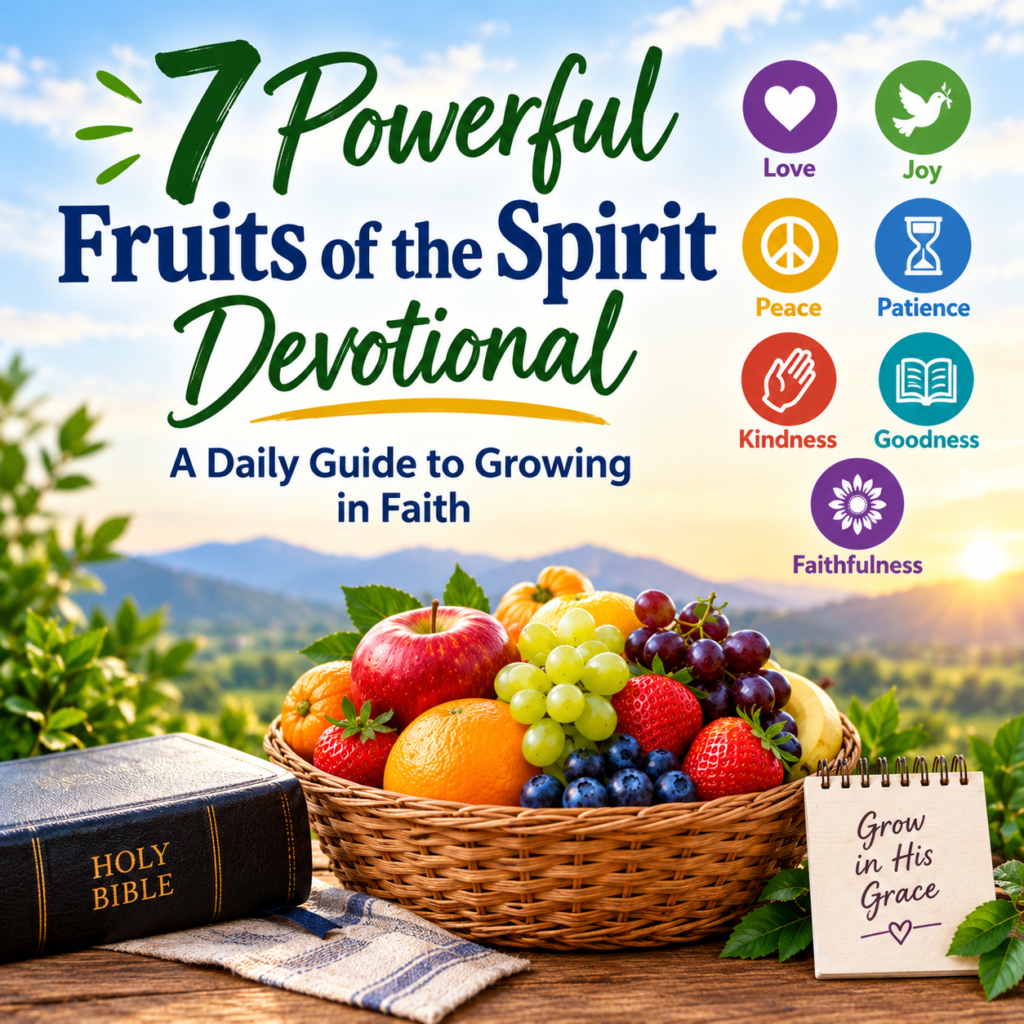
A Fruits of the Spirit devotional helps Christians move beyond simply knowing biblical teachings to practicing them in everyday life. It encourages believers to develop love, joy, peace, patience, kindness, goodness, faithfulness, gentleness, and self-control through a growing relationship with God.
The most meaningful spiritual growth often happens in ordinary moments: choosing patience during a difficult conversation, showing kindness when someone is unkind, or finding peace when life feels uncertain. These small decisions can reveal how faith is shaping a person’s character.
This devotional guide explores all nine fruits described in Galatians 5:22–23, with Scripture reflections, practical applications, prayer points, and daily challenges. It is designed for personal quiet time, family devotionals, small groups, and church Bible studies.
The goal is not perfection overnight. It is steady spiritual growth that becomes visible through everyday words, choices, relationships, and actions.
What Is a Fruits of the Spirit Devotional?
A devotional is a short period of focused spiritual reflection that usually includes Scripture, personal application, prayer, and a practical response. A Fruits of the Spirit devotional centers on the qualities that the Holy Spirit develops in a believer’s life.
The biblical foundation is Galatians 5:22–23, where the apostle Paul describes the fruit of the Spirit as love, joy, peace, patience, kindness, goodness, faithfulness, gentleness, and self-control.
These qualities are not merely a list of good manners. They describe a way of living that reflects Christian faith in relationships, responsibilities, and difficult circumstances.
The word fruit offers a helpful picture. Just as a healthy tree produces fruit over time, spiritual maturity develops through an ongoing relationship with God. Growth may be gradual, and believers may struggle with certain qualities more than others.
A daily devotional provides an opportunity to examine those areas honestly and invite God to shape them.
How to Use This Fruits of the Spirit Devotional
This devotional can be followed over nine days, with one day dedicated to each quality. It can also be used over nine weeks if a slower pace allows more time for reflection.
Each daily reading follows four simple steps:
- Read: Begin with the suggested Bible passage.
- Reflect: Consider what the passage teaches about Christian character.
- Pray: Ask God for help applying the lesson.
- Act: Choose one practical step to take during the day.
A journal can make this practice more meaningful. Readers may write down what challenged them, where they noticed progress, and which situations revealed a need for further growth.
The purpose is not to complete every reading perfectly. It is to become more intentional about living out biblical values.
Day 1: Love — Choosing to Care Beyond Convenience

Bible reading: 1 Corinthians 13:4–7
Love is the foundation of Christian character. It involves more than affection for family members or friends. Biblical love seeks the good of others, including people who are difficult to understand or disagree with.
In everyday life, love can look like listening without interrupting, offering help without expecting repayment, or responding with respect when a conversation becomes uncomfortable.
Imagine a family member speaking impatiently after a stressful day. A loving response does not require pretending that hurtful words are acceptable. Instead, it allows the person to respond honestly without trying to humiliate or punish the other person.
Love can be firm while remaining compassionate.
Reflection
- Does the way a person treats others reflect the love they profess?
- Is there someone they find difficult to treat with patience and respect?
- What would loving action look like in that relationship today?
Prayer
Heavenly Father, teach me to love with sincerity, patience, and humility. Help me care for others without seeking recognition. Give me wisdom to show compassion while maintaining healthy boundaries. Amen.
Today’s challenge: Perform one thoughtful act of kindness without telling anyone or expecting something in return.
Day 2: Joy — Finding Hope Beyond Circumstances
Bible reading: Philippians 4:4–7
Joy is not the same as constant happiness. Happiness may rise and fall with circumstances, but Christian joy is rooted in hope, gratitude, and trust in God.
A person can experience grief, disappointment, or exhaustion while still holding on to the belief that suffering does not have the final word.
This distinction matters because people sometimes feel guilty when they experience sadness. Yet biblical joy does not require denying painful emotions or pretending that everything is fine.
Instead, joy invites believers to recognize goodness even during difficult seasons.
A student who receives disappointing results, for example, may feel discouraged. Rather than allowing that disappointment to define their future, they can acknowledge the setback, seek guidance, learn from mistakes, and remain hopeful about what comes next.
Reflection
- What good things are easy to overlook during a difficult week?
- Has disappointment made it harder to recognize hope?
- How can gratitude and faith help create a healthier perspective?
Prayer
Lord, help me find lasting joy in Your presence rather than depending entirely on circumstances. Give me hope when I feel discouraged and a grateful heart when life feels ordinary. Amen.
Today’s challenge: Write down three things to be thankful for, including one small blessing that might normally go unnoticed.
Day 3: Peace — Trusting God in the Middle of Uncertainty
Bible reading: John 14:27
Peace does not mean a life without conflict, uncertainty, or responsibility. It describes an inner steadiness that helps a person face these experiences without being completely controlled by fear.
Modern life offers many reasons to feel unsettled: financial pressure, family disagreements, academic demands, and uncertainty about the future. Faith does not make these concerns disappear automatically, but it can change how a person responds to them.
Consider someone waiting for an important decision. They may repeatedly imagine negative outcomes and struggle to concentrate on anything else.
A peaceful response begins by distinguishing what can be controlled from what cannot. The person can prepare carefully, ask for support, pray honestly, and take the next responsible step without trying to predict every possible outcome.
Peace and practical action can exist together.
Reflection
- Which concern has been taking up too much mental space?
- What can be addressed today, and what must be left uncertain?
- Would prayer, quiet reflection, or a conversation with someone trustworthy help?
Prayer
God of peace, calm my heart when I face uncertainty. Help me act wisely where I have responsibility and trust You where I lack control. Guide my thoughts toward truth, courage, and hope. Amen.
Today’s challenge: Spend five quiet minutes in prayer. Name one concern, identify one practical step, and release the need to control every outcome.
Day 4: Patience — Learning to Wait Without Becoming Bitter
Bible reading: James 1:19–20
Patience is the ability to endure delays, frustrations, and difficult interactions without allowing irritation to dictate every response.
It is easy to appear patient when life follows a preferred schedule. The deeper test often comes when someone repeats a mistake, a plan changes unexpectedly, or progress takes longer than expected.
For example, a parent helping a child learn a new skill may need to explain the same instruction several times. A patient response recognizes that learning takes time rather than treating every mistake as a personal inconvenience.
Patience does not mean accepting harmful treatment indefinitely. It means responding thoughtfully instead of reacting impulsively, while still addressing problems that need attention.
Reflection
- Which situations most quickly trigger frustration?
- Do delays tend to produce anger, anxiety, or unkind words?
- How could a brief pause change the next response?
Prayer
Father, strengthen my patience when people or circumstances test me. Help me listen carefully, speak thoughtfully, and remember that growth takes time. Teach me to respond with wisdom rather than anger. Amen.
Today’s challenge: When frustration arises, pause before responding. Take a breath, listen fully, and choose words that address the issue without attacking the person.
Day 5: Kindness — Making Compassion Visible
Bible reading: Ephesians 4:31–32
Kindness transforms good intentions into actions that make others feel respected and valued. It is often expressed through ordinary choices rather than dramatic gestures.
A kind person notices when someone has been excluded from a conversation, offers help to a colleague who is overwhelmed, or checks on a friend who has become unusually quiet.
Kindness also matters in digital spaces. A thoughtful message can encourage someone, while a sarcastic comment posted in anger can create unnecessary pain.
In a culture where speed and personal achievement often receive attention, kindness reminds people that others are not obstacles or background characters. Every person deserves dignity.
Reflection
- Who might need encouragement or practical support today?
- Are online comments and private conversations marked by respect?
- Can kindness be shown without expecting praise?
Prayer
Lord, open my eyes to the needs of people around me. Help me speak with compassion, act generously, and treat others with dignity. May my kindness reflect the love You have shown me. Amen.
Today’s challenge: Send a sincere message of encouragement to someone who may need it, or offer practical help without waiting to be asked.
Day 6: Goodness — Doing What Is Right When No One Is Watching
Bible reading: Micah 6:8
Goodness involves choosing what is right, honest, and beneficial, even when an easier option is available. It goes beyond avoiding wrongdoing; it encourages people to contribute positively to the lives of others.
A person may demonstrate goodness by admitting a mistake at work, returning something that does not belong to them, or standing up for someone being treated unfairly.
These choices can be difficult because doing the right thing does not always bring immediate rewards. Honesty may feel uncomfortable, and defending someone may require courage.
However, goodness is not measured only by public acts of generosity. It also appears in private decisions that reflect integrity.
A Christian who values goodness seeks to align everyday behavior with faith, including when honesty costs time, convenience, or approval.
Reflection
- Are there areas where convenience has become more important than integrity?
- Is there a wrong that needs to be corrected?
- How can goodness benefit someone beyond the immediate situation?
Prayer
Heavenly Father, help me choose what is right even when it is difficult. Give me courage to act with integrity, compassion to serve others, and humility to acknowledge my mistakes. Amen.
Today’s challenge: Make one decision based on honesty and integrity, even if another option would be easier.
Day 7: Faithfulness — Remaining Dependable Through Every Season
Bible reading: Luke 16:10
Faithfulness is the quality of being trustworthy, consistent, and committed. It appears in the promises a person keeps, the responsibilities they fulfill, and the relationships they nurture over time.
Faithfulness is not limited to dramatic demonstrations of belief. It can be seen in a person who continues to pray during a difficult season, keeps a promise to a friend, or completes an important responsibility without constant reminders.
Consistency can feel less exciting than making a bold new commitment. Yet small acts of reliability build trust and give relationships a stronger foundation.
For instance, a friend who regularly checks in during a challenging period may provide more lasting comfort than someone who makes grand promises but rarely follows through.
Faithfulness also includes returning to spiritual practices after periods of distraction. Missing a devotional day does not mean that a person must abandon the habit altogether.
Reflection
- Do others experience this person as dependable?
- Is there a promise or responsibility that needs attention?
- Which spiritual practice could become more consistent?
Prayer
Lord, help me become a person others can trust. Strengthen my commitment to the responsibilities You have placed before me. When I become distracted or discouraged, help me begin again with humility and perseverance. Amen.
Today’s challenge: Complete one unfinished responsibility or follow through on a promise that has been delayed.
Day 8: Gentleness — Strength Under Control
Bible reading: Colossians 3:12–13
Gentleness is sometimes mistaken for weakness, but genuine gentleness requires strength. It involves controlling the way power, frustration, and disagreement are expressed.
A gentle person can speak firmly without humiliating others. They can correct a mistake without attacking someone’s worth, and they can disagree without turning every difference into a battle.
Imagine a manager discovering that an employee has made a costly mistake. An aggressive response might focus on blame and embarrassment. A gentle response would address the seriousness of the error, establish accountability, and explain how to prevent it from happening again.
The second approach does not ignore responsibility. It combines honesty with respect.
Gentleness is especially valuable in close relationships, where familiarity can make people careless with their words.
Reflection
- How does this person respond when feeling criticized?
- Can difficult truths be communicated without cruelty?
- Does the desire to win an argument sometimes become more important than understanding?
Prayer
God, teach me to use my words and influence with wisdom. Help me remain calm during disagreement and speak truth with compassion. Replace harshness with humility and give me strength to treat others respectfully. Amen.
Today’s challenge: During one difficult conversation, focus on understanding the other person before preparing a response.
Day 9: Self-Control — Choosing Wisdom Over Impulse
Bible reading: Proverbs 25:28
Self-control is the ability to manage impulses, emotions, and desires in ways that align with one’s values. It helps people pause between feeling something and deciding how to act.
Everyone experiences moments when an immediate reaction seems satisfying. Anger may encourage a sharp reply, anxiety may lead to repeated checking, and disappointment may tempt someone to abandon a worthwhile goal.
Self-control creates space for a more thoughtful choice.
For example, a person who feels provoked during an online discussion can decide not to publish an insulting comment. They may step away, reconsider the issue, and return when they can communicate more constructively.
This discipline can also support everyday habits, such as managing time, keeping commitments, limiting distractions, and following through on important responsibilities.
Self-control does not mean suppressing every emotion. It means acknowledging emotions without allowing them to make every decision.
Reflection
- Which impulse most often interferes with good judgment?
- What situations make it harder to maintain healthy habits?
- What boundary could make a wise response easier?
Prayer
Holy Spirit, strengthen me when I am tempted to act impulsively. Help me recognize my emotions without being ruled by them. Give me discipline to choose what is wise, loving, and faithful. Amen.
Today’s challenge: Identify one recurring distraction or unhelpful habit. Set one realistic boundary that makes a better choice easier.
How the Nine Fruits Work Together
The nine qualities described in Galatians 5:22–23 are closely connected. They should not be treated as unrelated personality traits or separate achievements.
Love influences how kindness is expressed. Patience helps gentleness remain present during conflict. Self-control supports faithfulness, while peace can help a person respond to pressure without abandoning goodness.
Consider a disagreement between two friends. Love encourages concern for both people. Patience allows each person to speak. Gentleness shapes the tone of the conversation, and self-control prevents anger from taking over.
Faithfulness helps the friends remain committed to resolving the issue, while goodness encourages an honest solution. Peace becomes possible when they seek understanding rather than victory.
This example shows how several spiritual qualities can operate together in a single moment.
A useful question for daily reflection is not simply, “Which fruit do I need most?” It is also, “How could these qualities work together in the situation I am facing?”
Common Mistakes When Studying the Fruits of the Spirit
A meaningful Fruits of the Spirit devotional should encourage spiritual growth without turning the process into a source of unnecessary guilt or comparison.
Mistake 1: Treating Spiritual Growth as a Competition
Some believers compare their behavior with that of others and conclude that they are spiritually mature because they appear more patient, generous, or disciplined.
Comparison can distract from honest self-examination. Another person’s journey does not provide a complete picture of their spiritual life.
A better approach is to focus on personal growth, seek guidance from Scripture, and remain open to correction.
Mistake 2: Expecting Instant Perfection
A person may pray for patience and still become frustrated the next day. Someone seeking self-control may make a poor decision despite sincerely wanting to change.
Such moments should prompt reflection rather than automatic despair. They can reveal triggers, habits, or relationships that require attention and support.
Spiritual maturity is not demonstrated by never making mistakes. It includes acknowledging wrongdoing, making amends when necessary, and continuing to grow.
This does not mean excusing repeated harmful behavior. Genuine growth involves responsibility, changed actions, and a willingness to seek help when needed.
A Simple Daily Routine for Spiritual Growth
The lessons from this Fruits of the Spirit devotional can become more meaningful when they are connected to a consistent routine.
1. Read Scripture for five minutes
Choose a short passage and read it slowly. Notice what it reveals about God, human behavior, or Christian responsibility.
2. Examine the heart honestly
Ask which attitude or behavior needs attention. The aim is honest reflection, not harsh self-criticism.
3. Choose one practical action
Turn the lesson into a specific decision, such as apologizing, keeping a promise, or listening patiently.
4. Review the day in the evening
Consider what went well, what was difficult, and what could be handled differently next time. End with prayer and gratitude.
The routine can take as little as 10–15 minutes. Consistency matters more than creating an elaborate schedule that becomes difficult to maintain.
Read more: 15 Free Fruits of the Spirit Coloring Pages: A Powerful Bible Activity for Kids and Families
Frequently Asked Questions
What is the main purpose of a Fruits of the Spirit devotional?
Its purpose is to help Christians understand and practice the nine qualities described in Galatians 5:22–23. Through Scripture, prayer, and practical reflection, readers can examine their character and seek to live out their faith more consistently.
What are the nine fruits of the Spirit in the Bible?
The nine qualities are love, joy, peace, patience, kindness, goodness, faithfulness, gentleness, and self-control. They appear in Galatians 5:22–23. Some Bible translations use words such as forbearance for patience or meekness for gentleness.
Can a Fruits of the Spirit devotional be used for a Bible study group?
Yes. Each daily reading can be used in a small group, Sunday school class, youth gathering, or family Bible study. Participants can read the passage, discuss the reflection questions, share appropriate examples, and pray together.
Group leaders should encourage honest discussion without pressuring participants to reveal private struggles.
How long should a daily devotional take?
A daily reading may take 10–15 minutes, although longer periods can provide more time for Bible study and journaling. The best routine is one that allows thoughtful reflection and can be maintained consistently.
How can someone grow in the fruits of the Spirit?
Christians can pursue growth through prayer, Scripture, worship, fellowship, honest self-examination, and practical acts of obedience. They can also seek wise counsel when persistent habits or difficult circumstances make change challenging.
Growth is not simply a matter of trying harder. In Christian teaching, it involves dependence on the Holy Spirit alongside a willingness to respond through daily choices.
Conclusion: Let Spiritual Growth Become Visible
The message of Galatians 5:22–23 offers a practical vision of Christian maturity. Love, joy, peace, patience, kindness, goodness, faithfulness, gentleness, and self-control are qualities that can shape the way believers respond to family, friends, strangers, and difficult circumstances.
A Fruits of the Spirit devotional gives readers an opportunity to slow down, reflect on Scripture, pray honestly, and make intentional changes in everyday life.
Some days may reveal encouraging progress. Other days may expose impatience, fear, selfishness, or a lack of discipline. Both can become opportunities for reflection, repentance, and renewed commitment.
The important thing is to keep returning to God and putting faith into practice.
Rather than trying to develop all nine qualities at once, readers can begin with one practical step today. They might choose patience during a stressful conversation, kindness toward someone who feels overlooked, or self-control when an impulsive response seems tempting.
Over time, these choices can help make Christian character more visible in ordinary life.
Take the next step: Read Galatians 5:22–23 today, choose the fruit that most needs attention in the current season of life, and pray for guidance in practicing it. Readers can also share this devotional with a friend, family member, or Bible study group to encourage spiritual growth together.