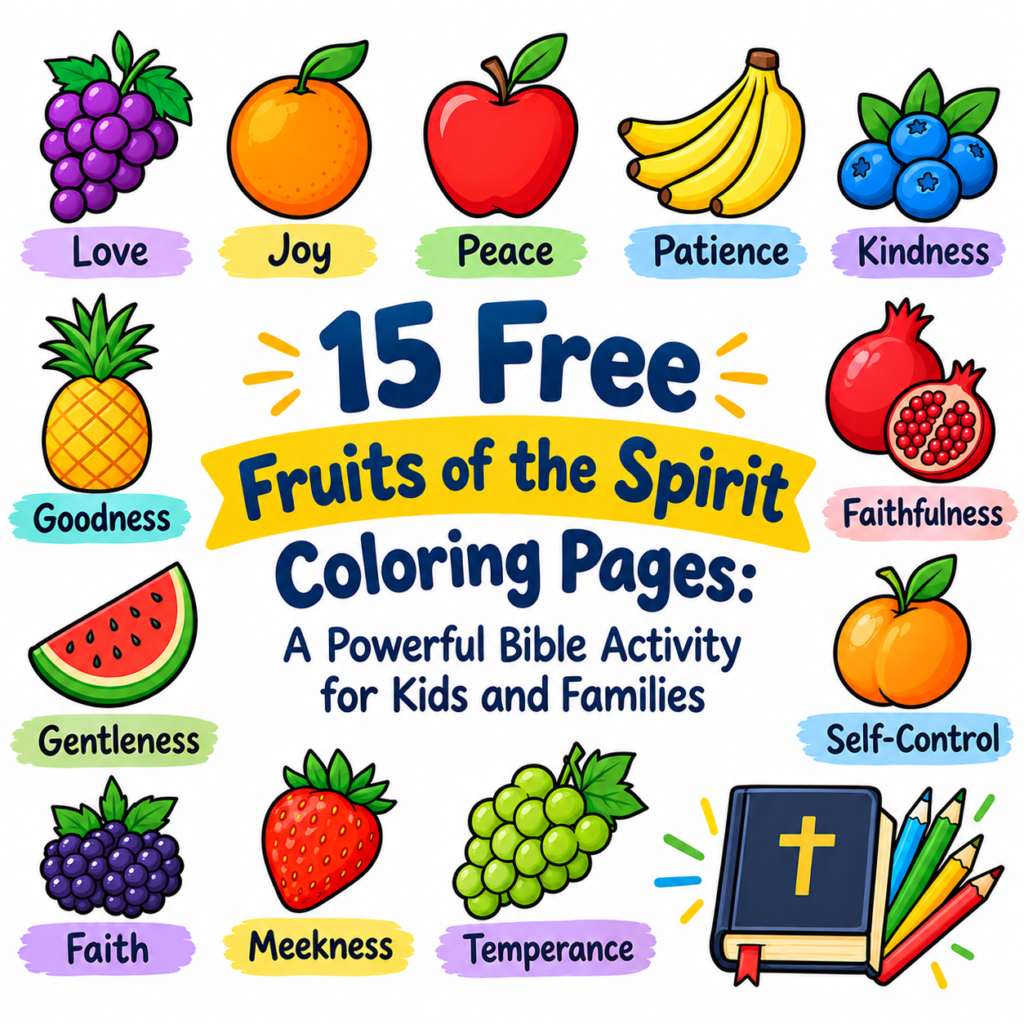
Fruits of the Spirit coloring pages offer a creative way for children, parents, Sunday school teachers, and church groups to explore nine important Christian qualities: love, joy, peace, patience, kindness, goodness, faithfulness, gentleness, and self-control. Through simple illustrations, meaningful Bible lessons, and everyday examples, coloring can become more than an enjoyable activity. It can help children connect biblical teachings with the way they treat others.
For families looking for faith-based activities, these printable pages can make Bible study more engaging and memorable. Children can color a heart representing love, a smiling sun representing joy, or a peaceful landscape representing peace while learning what each quality means in everyday life.
This guide explains the meaning of the nine Fruits of the Spirit, how to use coloring activities for Christian education, which designs work best for different ages, and how parents and teachers can turn a simple coloring sheet into a meaningful faith-building experience.
What Are the Fruits of the Spirit?
The Fruits of the Spirit are nine qualities described in Galatians 5:22–23 in the Bible. They represent the character that develops in a person’s life through the work of the Holy Spirit.
According to the passage, these qualities are love, joy, peace, patience, kindness, goodness, faithfulness, gentleness, and self-control.
Rather than treating these qualities as a list children must memorize, parents and teachers can explain them through familiar situations. For example, sharing toys demonstrates kindness, waiting for a turn practices patience, and telling the truth reflects faithfulness.
Fruits of the Spirit coloring pages make these abstract ideas easier for young learners to understand. Each page can focus on one quality, using a recognizable symbol and a short explanation.
Why Are They Called Fruits?
The Bible uses the image of fruit to describe qualities that grow from a healthy spiritual life. Just as a fruit tree produces fruit as it grows, Christians seek to develop Christlike character as their faith matures.
This comparison gives children a simple way to understand spiritual growth. Learning to be patient or gentle does not always happen immediately. These qualities develop through practice, prayer, guidance, and everyday experiences.
Coloring activities can introduce the concept without making children feel that they must be perfect. The goal is to help them understand, practice, and gradually develop these qualities.
9 Fruits of the Spirit Coloring Pages and Their Meanings
Each of the nine biblical qualities offers an opportunity to combine creativity with a practical lesson. The following ideas can guide parents, teachers, and children’s ministry leaders when choosing or creating printable coloring sheets.
1. Love Coloring Pages
<text>Love is often represented by a heart, a family, helping hands, or children caring for one another.</text>
Love means showing care, respect, and concern for others. Children can practice love by including someone who feels left out, helping a sibling, or comforting a friend who is upset.
A love-themed coloring sheet might feature a large heart surrounded by smaller hearts and the words “Love One Another.”
Activity idea: Ask children to name one loving thing they can do for someone today. They can write their answer below the picture.
2. Joy Coloring Pages
Joy is often illustrated with sunshine, flowers, smiling faces, rainbows, or musical notes.
Joy is more than feeling happy when everything goes well. In Christian teaching, joy can also mean having hope and gratitude during difficult circumstances.
Children can explore this idea by identifying things they appreciate, such as family, friendship, nature, or the opportunity to help someone.
Activity idea: Invite children to color a joyful scene and name three things they are thankful for.
3. Peace Coloring Pages
Peace-themed illustrations may include doves, calm water, clouds, olive branches, or a quiet garden.
Peace involves seeking calm, reconciliation, and harmony rather than responding to every disagreement with anger. Children can practice peace by using gentle words, listening to another person’s point of view, and asking for help when conflicts arise.
Activity idea: After coloring a peaceful landscape, ask children what they could do when an argument begins.
4. Patience Coloring Pages
Patience can be represented by a growing plant, a caterpillar becoming a butterfly, a clock, or a child waiting for a turn.
Patience means learning to wait without becoming unnecessarily angry or giving up. It is especially relevant when children experience disappointment, struggle with a difficult task, or need to share attention with others.
Activity idea: Use a flower-growing illustration and explain that meaningful growth often takes time. Ask children to describe a situation in which waiting patiently can help.
5. Kindness Coloring Pages
Kindness illustrations often show children sharing, helping older people, caring for animals, or offering friendship.
Kindness involves noticing what others need and responding with consideration. Small actions, such as sharing supplies or welcoming a new student, can make a real difference.
Activity idea: Have each child color a picture of someone helping another person and identify one kind action they can practice during the week.
6. Goodness Coloring Pages
Goodness can be illustrated through helping hands, a basket of fruit, a garden, or children doing something honest and helpful.
Goodness involves choosing what is right and beneficial, even when nobody is watching. Children can begin understanding it through simple choices, such as admitting a mistake, returning something that does not belong to them, or helping without expecting a reward.
Activity idea: Ask children to draw or color an example of doing the right thing when it might be easier to do otherwise.
7. Faithfulness Coloring Pages
Faithfulness may be represented by a Bible, a lighthouse, clasped hands, or friends keeping a promise.
Faithfulness means being trustworthy, dependable, and committed. For children, it can involve keeping promises, telling the truth, completing responsibilities, and remembering that trust is built through consistent actions.
Activity idea: Invite children to color a lighthouse and discuss how people can be dependable sources of support for others.
8. Gentleness Coloring Pages
Gentleness-themed pictures may include a shepherd caring for a lamb, a child holding a small bird, or someone comforting a friend.
Gentleness means treating others with care and respect. It does not mean being weak. A gentle person can be confident while choosing words and actions that avoid unnecessary harm.
Activity idea: Ask children to color a picture of someone caring for an animal and discuss how gentle behavior can help others feel safe.
9. Self-Control Coloring Pages
Self-control illustrations might feature a stop sign, a child taking a deep breath, or a traffic light.
Self-control means managing reactions, impulses, and choices. Children can learn to pause before shouting, think before acting, and choose a helpful response when frustrated.
Activity idea: Teach a simple three-step routine: stop, take a breath, and choose what to do next. Children can write these steps beside their coloring picture.
How to Use Fruits of the Spirit Coloring Pages at Home
Coloring activities are most effective when adults connect the picture to real life. A finished page can become a conversation starter rather than simply another piece of artwork.
Choose One Fruit at a Time
Start with one quality that suits the child’s age and current experiences. Younger children may understand kindness through sharing, while older children may benefit from discussing faithfulness or self-control.
Introduce the word, explain its meaning in simple language, and give one example from everyday life.
Read a Related Bible Passage
Galatians 5:22–23 is the central biblical passage for this activity. Families can read it together before coloring or focus on one quality during each session.
For example, a lesson about patience can include a short discussion about waiting, listening, and responding calmly. The coloring sheet then reinforces the theme.
Ask Questions While Children Color
A relaxed conversation can help children think more deeply about the lesson. Adults might ask:
- What does this picture remind you of?
- When is it difficult to show this quality?
- How could you practice it at school or at home?
- What could you do if you make a mistake?
These questions encourage reflection without turning the activity into a test.
Display the Finished Artwork
Children often enjoy seeing their work displayed on a refrigerator, bedroom wall, classroom board, or church activity display.
A collection of nine completed pictures can become a visual reminder of the biblical qualities. Families may also create a small booklet by arranging the pages in the order they appear in Galatians 5:22–23.
Fruits of the Spirit Coloring Pages for Sunday School
Sunday school teachers can use these printables for individual activities, small groups, or a series of lessons.
One practical approach is to introduce a different quality each week. The teacher reads the Bible passage, explains the meaning, gives a relatable example, and allows children to color a related illustration.
For a shorter session, children can color one page while the teacher discusses a real-life situation. For example, a story about sharing classroom materials can introduce kindness, while a story about waiting for a turn can introduce patience.
Teachers can also organize a matching game. Place the nine qualities on cards and ask children to match each word with an illustration or a short scenario.
The activity should remain welcoming to children with different abilities and learning styles. Some may enjoy detailed coloring, while others may prefer large shapes, stickers, or drawing their own symbols.
Coloring Activities for Different Age Groups
The best design depends on the child’s age, fine-motor skills, reading ability, and interests.
Preschool Children
Preschoolers generally benefit from large, simple outlines and familiar symbols. Hearts, smiling suns, flowers, and animals are easier to color than detailed scenes.
Adults can explain each quality in one short sentence. For example, “Kindness means treating people with care.”
Elementary School Children
Elementary-age children can work with more detailed illustrations and short Bible verses. They may enjoy tracing the names of the nine qualities, completing a matching exercise, or writing an example beneath each picture.
At this age, discussion is especially useful because children encounter friendship challenges, disagreements, and growing responsibilities.
Older Children and Preteens
Older children may prefer creative designs that leave room for personal expression. They can add their own symbols, decorate lettering, or write a short reflection on how a particular quality applies to their lives.
Rather than presenting the lesson as a list of rules, encourage them to think about difficult choices, forgiveness, peer pressure, and responsible decision-making.
Tips for Printing and Using Coloring Sheets
A few practical decisions can make the activity easier for families and teachers.
- Choose clear outlines: Simple black-and-white designs are easy to print and leave plenty of room for coloring.
- Check the page size: US Letter and A4 are common paper sizes. Select the format that suits the printer.
- Use suitable materials: Crayons and colored pencils work well for most worksheets. Washable markers may be better for supervised activities.
- Preview the design: Check that the text is readable and the illustrations are not cut off.
- Consider accessibility: Larger shapes, high-contrast outlines, and minimal background details can help children who find intricate coloring difficult.
- Check usage rights: Confirm that a printable is free for the intended use. Personal-use permission does not automatically allow commercial reproduction or redistribution.
Parents and teachers can also create their own coloring sheets using simple shapes and handwritten labels. A homemade activity can be personalized for a particular lesson, age group, or classroom theme.
Common Mistakes to Avoid
Treating the Nine Qualities as a Test of Perfection
Children may sometimes become impatient, speak unkindly, or struggle to manage their emotions. These moments are opportunities to teach and practice, not reasons to label a child as bad.
Adults can acknowledge the behavior, discuss its effect on others, and help the child identify a better response for next time.
Focusing Only on Completing the Picture
A beautifully colored page can be enjoyable, but the educational value comes from connecting the activity to the meaning behind it.
A short discussion or practical challenge can make the lesson more memorable. Even asking a single thoughtful question may help a child connect the biblical quality with everyday behavior.
Read more: Develop the Fruits of the Spirit: 9 Powerful Ways to Build a Christ-Centered Life
Frequently Asked Questions
What Are Fruits of the Spirit Coloring Pages?
Fruits of the Spirit coloring pages are Christian-themed printable activities based on the nine qualities in Galatians 5:22–23. They commonly feature symbols, Bible verses, and illustrations that help children explore love, joy, peace, patience, kindness, goodness, faithfulness, gentleness, and self-control.
Are Fruits of the Spirit Coloring Pages Free?
Some websites, churches, and educational resources offer free printable pages. However, availability and permitted uses vary. Before downloading or sharing a design, check its licensing terms and whether it is free for personal, classroom, or church use.
What Bible Verse Lists the Nine Fruits of the Spirit?
Galatians 5:22–23 lists the nine qualities. The precise wording can differ slightly between Bible translations, so families and teachers can use the translation preferred by their church or household.
How Can Teachers Use These Coloring Pages in Sunday School?
Teachers can introduce a quality, read the related Bible passage, explain the concept, and give children a corresponding coloring activity. A short discussion, matching game, or weekly kindness challenge can reinforce the lesson.
What Is the Best Age for These Coloring Activities?
Preschool and elementary-age children often enjoy simple coloring pages, while older children may prefer detailed illustrations and written reflections. With suitable adaptations, the activities can work for a broad range of ages.
Can Adults Use Fruits of the Spirit Coloring Pages?
Yes. Adults can use faith-based coloring as a quiet devotional activity, a Bible study aid, or a creative way to reflect on spiritual growth. The pages can also support family discussions across generations.
Conclusion: Turn Coloring Time Into a Meaningful Faith Activity
Fruits of the Spirit coloring pages combine creativity with an accessible introduction to nine important Christian qualities. They give children a visual way to explore biblical teachings while helping parents, teachers, and church leaders begin practical conversations about character.
The most meaningful activity does not have to be complicated. One printable, a short Bible reading, and a thoughtful question can create an opportunity for learning and connection.
Families and teachers can start with one quality, choose a suitable illustration, and encourage children to practice that lesson during the week. Over time, these small activities can help make biblical values part of everyday conversations and choices.
Ready to begin? Choose a favorite Fruits of the Spirit coloring page, gather the crayons, read Galatians 5:22–23 together, and invite each child to identify one way to put the lesson into practice.