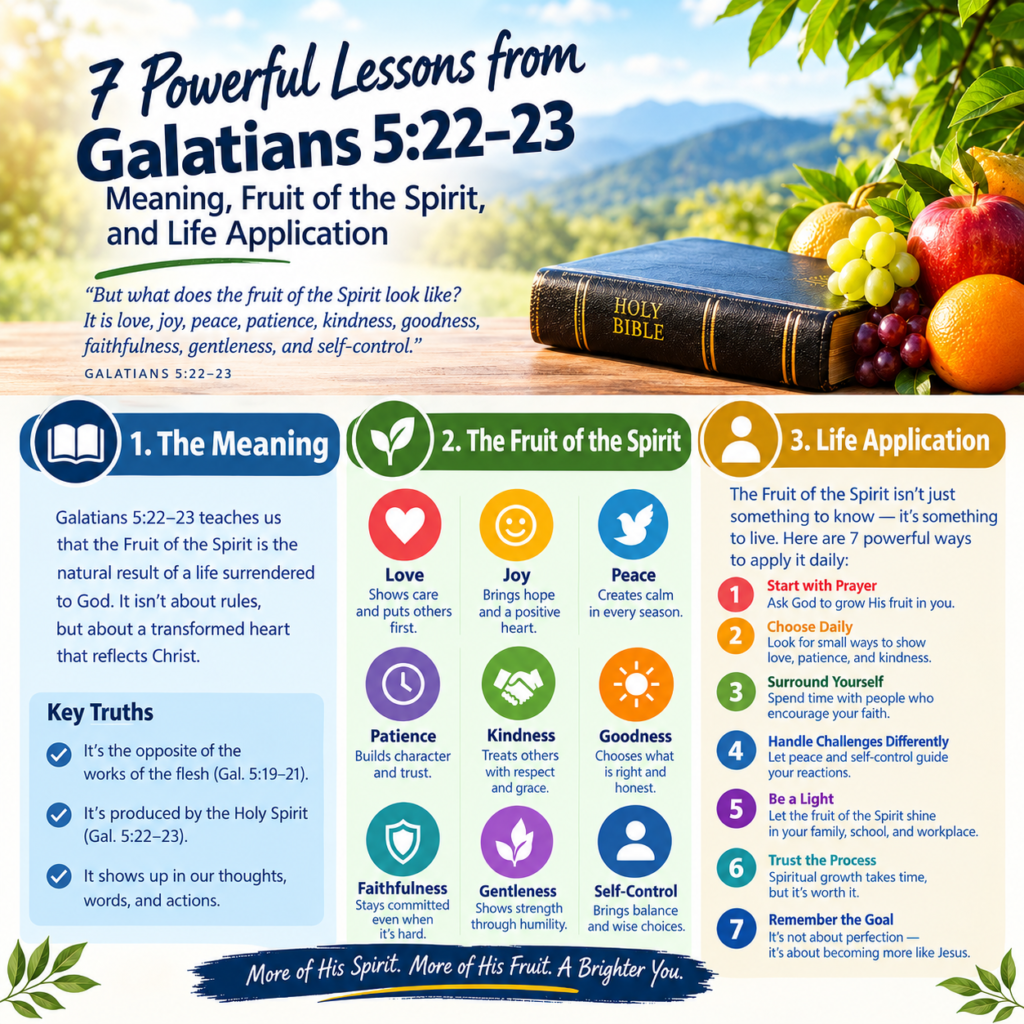
Galatians 5:22–23 offers a powerful picture of what a spiritually mature life can look like. In a world that often measures success through money, popularity, achievement, and appearance, these verses direct attention toward something deeper: the character a person develops through a relationship with God.
The passage describes the fruit of the Spirit, including love, joy, peace, patience, kindness, goodness, faithfulness, gentleness, and self-control. These qualities are not simply good manners or personality traits. Within the Christian faith, they represent the work of the Holy Spirit in shaping a believer’s heart, decisions, relationships, and daily conduct.
Understanding Galatians 5:22–23 can help Christians reflect on how they respond to conflict, treat other people, manage difficult emotions, and grow through challenging circumstances. It also offers a practical framework for parents, teachers, church leaders, students, and anyone seeking to live with greater compassion and integrity.
This guide explores the biblical meaning of the passage, explains each fruit of the Spirit, addresses common misunderstandings, and shares practical ways to apply these timeless teachings to everyday life.
What Is the Meaning of Galatians 5:22–23?
The Apostle Paul wrote the Letter to the Galatians to address questions about Christian freedom, faith, and life under the guidance of the Holy Spirit. In chapter 5, he contrasts the destructive patterns of human nature with the character produced by the Spirit.
Galatians 5:22–23 explains that the fruit of the Spirit consists of nine qualities that become increasingly visible in a believer’s life.
The passage reads in the King James Version (KJV):
But the fruit of the Spirit is love, joy, peace, longsuffering, gentleness, goodness, faith,
Meekness, temperance: against such there is no law.
Modern translations often use patience instead of longsuffering, kindness instead of gentleness, faithfulness instead of faith, and self-control instead of temperance. These wording differences help readers understand the meaning of the original passage.
The central message is that spiritual growth involves more than knowing religious teachings. It involves allowing God’s Spirit to influence how people think, speak, choose, and behave.
Why Does Paul Use the Word “Fruit”?
Fruit is a meaningful metaphor because it suggests growth, development, and visible results.
A healthy tree produces fruit according to its nature. Similarly, Paul describes the qualities that emerge when a person’s life is shaped by the Holy Spirit.
Fruit does not appear instantly. Trees require time, nourishment, suitable conditions, and care. Spiritual maturity also develops over time through prayer, obedience, reflection, worship, and daily choices.
This illustration encourages believers to focus not only on outward religious activity but also on the character growing within them.
The Nine Fruits of the Spirit Explained
Each quality in Galatians 5:22–23 offers a different perspective on Christian character. Together, they describe a life shaped by love, emotional steadiness, moral goodness, and responsible action.
1. Love: Choosing the Good of Others
Love appears first because it is central to Christian teaching. Biblical love goes beyond affection or warm feelings. It includes seeking another person’s good, showing compassion, and acting with integrity even when doing so is inconvenient.
For example, a person might disagree strongly with a colleague yet still listen respectfully rather than attempting to humiliate them. A parent might correct a child’s behavior without attacking the child’s worth.
Love also includes healthy boundaries. It does not require someone to tolerate abuse, accept dishonesty, or ignore injustice.
Practical application: Before responding to someone who has caused frustration, consider whether the response will promote understanding, fairness, and dignity.
2. Joy: Finding Hope Beyond Circumstances
Joy is a deep sense of hope and spiritual confidence that is not entirely dependent on external circumstances.
Happiness often rises and falls with events. A successful examination, a family celebration, or a professional achievement may produce happiness. Disappointment, loss, or uncertainty may reduce it.
Spiritual joy can coexist with grief and sadness. A Christian experiencing hardship does not need to pretend everything is fine to demonstrate faith.
For example, a student who fails an important examination may feel disappointed while still maintaining hope, seeking support, and preparing to try again.
Practical application: Practice gratitude by identifying meaningful blessings, supportive relationships, and reasons for hope without denying genuine difficulties.
3. Peace: Developing Inner Stability
Peace refers to a sense of spiritual steadiness and a commitment to harmony. It includes trust in God, but it can also influence the way people approach disagreements and uncertainty.
A peaceful person does not necessarily avoid every difficult conversation. Sometimes peace requires addressing a problem honestly rather than allowing resentment to grow.
Consider a family disagreement. Instead of shouting or refusing to communicate, a person can pause, explain the concern clearly, and listen to the other person’s perspective.
Peace does not mean controlling every situation. It means responding thoughtfully even when circumstances remain uncertain.
Practical application: When tension rises, take a moment to breathe, pray, clarify the real issue, and choose words that encourage resolution rather than escalation.
4. Patience: Allowing Growth to Take Time
Patience, called longsuffering in the KJV, involves enduring difficulties and responding to frustration without becoming unnecessarily harsh.
It is particularly important in relationships because people have different abilities, expectations, and rates of development.
A teacher may need to explain a difficult concept several times. A caregiver may need to provide repeated encouragement. A friend may need time to recover from disappointment.
Patience does not mean ignoring harmful behavior or refusing to make decisions. It means avoiding unnecessary anger and allowing appropriate time for learning, understanding, and change.
Practical application: Identify one situation that repeatedly tests patience and plan a calmer response before it happens again.
5. Kindness: Making Compassion Visible
Kindness turns good intentions into practical actions. It can appear in a thoughtful message, a sincere apology, a willingness to help, or a respectful conversation with someone who feels overlooked.
Small acts of kindness often have a greater effect than people realize.
A student who includes an isolated classmate can help that person feel welcome. A manager who acknowledges an employee’s effort can strengthen trust. A neighbor who offers assistance during a difficult week can reduce another person’s burden.
Kindness is not limited to people who can return a favor. It reflects a willingness to treat others with consideration because their dignity matters.
Practical application: Perform one intentional act of kindness each day without expecting recognition or repayment.
6. Goodness: Choosing What Is Right
Goodness involves moral integrity, generosity, and a commitment to doing what is right.
Kindness may focus on a compassionate action, while goodness also emphasizes the underlying commitment to righteousness and ethical conduct.
For example, an employee who discovers an accounting error might report it even when correcting it creates extra work. A student who finds another person’s lost property might return it rather than keeping it.
Goodness becomes especially meaningful when the right choice is less convenient than the wrong one.
Practical application: Ask whether a decision is honest, fair, and consistent with personal Christian convictions, even when no one else is watching.
7. Faithfulness: Becoming Someone Others Can Trust
Faithfulness means reliability, loyalty, and steadfast commitment. In Christian life, it includes remaining devoted to God and following through on responsibilities.
Faithfulness can be expressed through keeping promises, honoring commitments, telling the truth, and remaining dependable during difficult seasons.
For example, a friend who listens when life becomes complicated demonstrates loyalty through action. A church volunteer who consistently fulfills responsibilities shows that service is more than a passing interest.
Faithfulness does not mean remaining committed to every situation regardless of harm. Wisdom is necessary when promises, responsibilities, and personal safety come into conflict.
Practical application: Make fewer promises if necessary, but take reasonable steps to fulfill the commitments that are made.
8. Gentleness: Combining Strength With Compassion
Gentleness, also translated as meekness, is sometimes misunderstood as weakness. In the biblical context, it is better understood as humility, consideration, and strength expressed without unnecessary harshness.
A gentle person can disagree, establish boundaries, correct mistakes, and defend someone who is being mistreated.
The difference lies in the manner of response. Gentleness does not require humiliation, intimidation, or uncontrolled anger.
Imagine a supervisor correcting an employee’s mistake. One approach involves public embarrassment. Another involves explaining the problem privately, providing clear guidance, and giving the employee an opportunity to improve.
Both approaches address the mistake, but only the second demonstrates consideration for the person’s dignity.
Practical application: Speak firmly when necessary, but avoid insults, contempt, and attempts to make others feel inferior.
9. Self-Control: Managing Desires and Reactions
Self-control, known as temperance in the KJV, is the ability to regulate impulses, desires, words, and behavior.
It is important because strong emotions can influence decisions before a person has considered the consequences.
Someone who feels angry may want to send an insulting message. Someone who feels anxious may repeatedly avoid a necessary responsibility. Someone who wants immediate gratification may sacrifice a more important long-term goal.
Self-control creates space between an impulse and an action. It allows people to consider their values and choose a more responsible response.
It does not mean suppressing every emotion. Anger, sadness, fear, and excitement are normal human experiences. The goal is to respond to emotions wisely rather than allowing them to dictate every decision.
Practical application: When experiencing a strong impulse, pause before acting and consider the likely consequences of the decision.
How Galatians 5:22–23 Connects to Everyday Life
The practical value of Galatians 5:22–23 becomes clearer when these qualities are considered together rather than separately.
A person may demonstrate patience during a disagreement but struggle to remain kind afterward. Another may show generosity while finding it difficult to control anger. Spiritual growth involves allowing the different qualities to shape a person’s overall character.
The following examples illustrate how the fruit of the Spirit can influence ordinary situations.
| Everyday situation | Fruit of the Spirit | Practical response |
|---|---|---|
| A disagreement with a friend | Love and gentleness | Listen carefully and speak respectfully. |
| A disappointing result | Joy and faithfulness | Acknowledge disappointment and continue working toward a meaningful goal. |
| A stressful deadline | Peace and self-control | Prioritize tasks instead of reacting impulsively. |
| A difficult family relationship | Patience and kindness | Communicate calmly while maintaining appropriate boundaries. |
| An ethical dilemma | Goodness and faithfulness | Choose honesty even when dishonesty seems easier. |
These examples demonstrate that spiritual maturity is not limited to church services, Bible study, or formal prayer. It can influence ordinary decisions at home, at school, at work, and in the wider community.
What Does Galatians 5:22–23 Teach About Spiritual Growth?
The passage offers several important lessons about how Christian character develops.
Spiritual Growth Is a Process
People rarely develop every virtue perfectly at once. One believer may struggle with patience, while another may need to work on self-control or gentleness.
Recognizing these weaknesses can become an opportunity for growth rather than a reason for despair.
Progress may involve noticing an unhelpful reaction sooner, apologizing more sincerely, or responding more calmly than before.
Character Matters More Than Appearance
Religious participation can be meaningful, but outward activity alone does not demonstrate every aspect of spiritual maturity.
Galatians 5:22–23 directs attention toward the quality of a person’s life and relationships. A believer’s words, conduct, honesty, and treatment of others are important expressions of faith.
This does not mean Christians must be perfect. Rather, it encourages them to examine whether their lives increasingly reflect the values they profess.
Christian Freedom Includes Responsibility
Earlier in Galatians 5, Paul discusses Christian freedom and warns against using freedom to serve selfish desires. He encourages believers to serve one another through love.
The fruit of the Spirit therefore provides a framework for understanding freedom as more than doing whatever one wants.
Freedom can include choosing restraint, forgiving thoughtfully, acting generously, and refusing to let destructive impulses govern behavior.
Common Misunderstandings About the Fruit of the Spirit
Even familiar Bible passages can be misunderstood when individual words are separated from their wider context.
Misunderstanding 1: Christians Must Always Feel Happy and Peaceful
Joy and peace do not require a person to feel cheerful at every moment.
Grief, fear, frustration, and disappointment are normal human experiences. The presence of difficult emotions does not automatically indicate a lack of faith.
The fruit of the Spirit concerns the broader direction of a person’s character and responses, not an expectation of constant emotional comfort.
Misunderstanding 2: Gentleness and Patience Mean Accepting Everything
Patience is not permission for others to exploit someone. Gentleness does not require silence in the face of injustice.
A Christian can respond with compassion while setting boundaries, seeking help, correcting wrongdoing, or protecting a vulnerable person.
The challenge is to pursue what is right without abandoning dignity, wisdom, and self-control.
How to Apply Galatians 5:22–23 in Daily Life
Understanding the passage is valuable, but its practical significance becomes clearer when readers turn its principles into daily habits.
A simple routine can help believers reflect on their choices without becoming overwhelmed by the desire to change everything at once.
- Begin with reflection. Spend a few minutes reading the passage and considering which quality feels most relevant to the day ahead.
- Choose one practical action. For example, practice patience during a difficult conversation or demonstrate kindness toward someone who feels excluded.
- Notice emotional triggers. Pay attention to situations that commonly produce anger, jealousy, fear, or impatience.
- Pause before reacting. Use prayer, thoughtful breathing, or a brief break to create space for a wiser response.
- Review the day honestly. Consider what went well, where mistakes occurred, and what could be handled differently next time.
- Make amends when necessary. If an action harms someone, offer a sincere apology and take reasonable steps to repair the relationship.
- Continue practicing. Treat spiritual development as an ongoing process rather than a test that must be passed perfectly.
These habits are not a formula for earning God’s love. Within Christian teaching, they are practical ways of cooperating with spiritual growth and allowing faith to influence daily conduct.
Read more: 7 Powerful Lessons from Galatians 6: Biblical Meaning, Explanation, and Life Application
Frequently Asked Questions About Galatians 5:22–23
What are the nine fruits of the Spirit in Galatians 5:22–23?
The nine qualities are love, joy, peace, patience, kindness, goodness, faithfulness, gentleness, and self-control. The King James Version uses longsuffering, gentleness, faith, meekness, and temperance in the corresponding list.
What is the main message of Galatians 5:22–23?
The passage teaches that the Holy Spirit produces godly character in believers. It encourages Christians to develop qualities that influence their relationships, decisions, attitudes, and responses to life’s challenges.
Why does the Bible call these qualities the fruit of the Spirit?
The image of fruit suggests that healthy spiritual life produces visible results over time. As a tree bears fruit, the passage describes virtues that become evident as a believer’s life is shaped by the Holy Spirit.
How can someone develop the fruit of the Spirit?
Christians commonly cultivate spiritual growth through prayer, Scripture reading, worship, fellowship, reflection, and practical obedience. These practices can help believers recognize weaknesses and make choices that reflect their faith.
Is the fruit of the Spirit different from the gifts of the Spirit?
Yes. The fruit of the Spirit describes qualities of Christian character, while spiritual gifts refer to abilities or forms of service associated with the Holy Spirit’s work. Both are discussed in the New Testament, but they serve different purposes.
What does “against such there is no law” mean?
At the end of Galatians 5:23, Paul explains that there is no law against these virtues. Qualities such as love, kindness, goodness, and self-control are consistent with moral goodness rather than behaviors that need to be prohibited.
Conclusion: Living Out the Message of Galatians 5:22–23
Galatians 5:22–23 provides a lasting guide to Christian character. Its nine qualities encourage believers to approach life with love, joy, peace, patience, kindness, goodness, faithfulness, gentleness, and self-control.
These virtues become meaningful through everyday choices: listening when it would be easier to argue, remaining honest when dishonesty seems convenient, showing compassion without abandoning healthy boundaries, and responding thoughtfully when emotions become intense.
Spiritual growth does not require perfection overnight. It calls for humility, consistent effort, and a willingness to let God shape the way a person lives.
The most valuable response to this passage is not simply memorizing the list. It is choosing one quality to practice today and allowing that choice to influence relationships, responsibilities, and decisions.
A practical challenge: Choose the fruit of the Spirit that you find most difficult to demonstrate and identify one specific action that will help you practice it this week. Return to Galatians 5:22–23 regularly and reflect on the progress that follows.