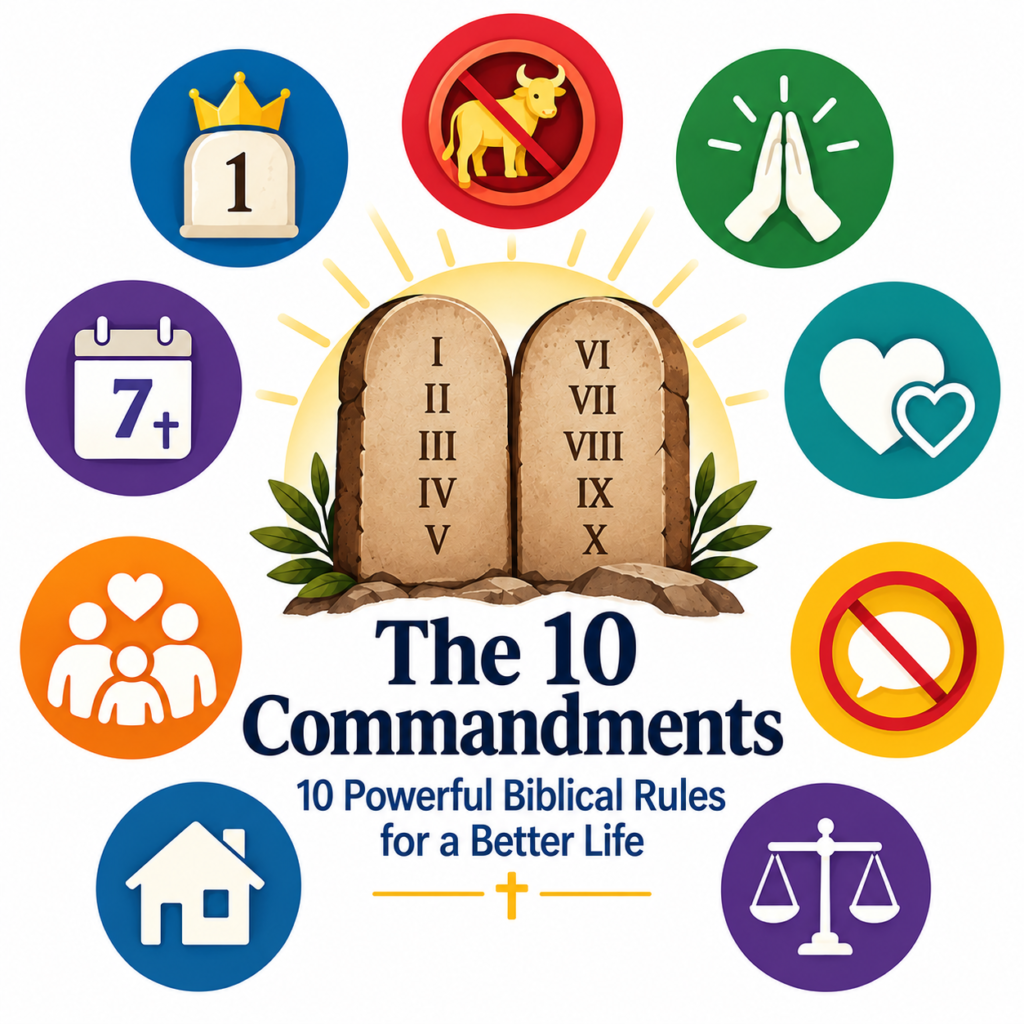
The Ten Commandments are among the best-known teachings in the Bible, yet their deeper meaning extends far beyond memorising a list of religious rules. They address questions that remain important in everyday life: How should people treat one another? What deserves their loyalty? Why do honesty, faithfulness, and self-control matter?
For Christians, the Ten Commandments provide a foundation for understanding God’s expectations and building a life guided by faith. Their principles also invite thoughtful reflection on personal responsibility, family relationships, integrity, and the difference between genuine fulfilment and selfish ambition.
The commandments appear in Exodus 20:1–17 and Deuteronomy 5:6–21. In the biblical account, God gives these instructions to the Israelites through Moses. They become a central part of Israel’s covenant relationship with God and its understanding of a faithful community. Exodus 20:1–17 records the commandments in their biblical setting.
This guide explains the 10 Commandments in simple English, explores what each one means, and shows how their underlying principles can be applied to modern life.
What Are the 10 Commandments?
The 10 Commandments are biblical instructions concerning humanity’s relationship with God and responsibilities toward other people. They are traditionally understood as ten foundational teachings given to the Israelites at Mount Sinai.
The first commandments focus primarily on worship, reverence, and devotion to God. The remaining commandments address matters such as respect for parents, protection of life, marital faithfulness, property, truthfulness, and contentment.
The two principal biblical passages containing the commandments are Exodus 20:1–17 and Deuteronomy 5:6–21. Although the wording and presentation differ slightly, both passages communicate the same foundational principles.
Different Christian traditions number some of the commandments differently. For example, Catholic and Lutheran traditions generally combine the prohibitions concerning other gods and idols into one commandment, while dividing the final prohibition against coveting into two. Other traditions number them separately. The list below follows the widely used Protestant and Anglican arrangement. Church of England: The Commandments.
The 10 Commandments List in Simple English
Here is a simple summary of the ten commandments:
- You shall have no other gods before Me. Put God first in life.
- You shall not make or worship idols. Do not give created things the place that belongs to God.
- You shall not take the Lord’s name in vain. Treat God’s name with respect.
- Remember the Sabbath day and keep it holy. Set aside sacred time for worship and rest.
- Honour your father and your mother. Treat parents with respect and appropriate care.
- You shall not murder. Respect and protect human life.
- You shall not commit adultery. Honour marital faithfulness.
- You shall not steal. Respect what belongs to others.
- You shall not bear false witness against your neighbour. Tell the truth and avoid false accusations.
- You shall not covet what belongs to your neighbour. Resist envy and uncontrolled desire for another person’s possessions or relationships.
These short descriptions make the commandments easier to remember. Their full significance, however, becomes clearer when each is considered in its biblical context and applied to everyday decisions.
1. You Shall Have No Other Gods Before Me
The first commandment calls people to give God the highest place in their lives. In Exodus 20:3, God instructs the Israelites not to place other gods before Him.
In the ancient world, different communities worshipped different deities. This commandment established Israel’s exclusive commitment to the God who had brought the people out of slavery in Egypt.
For Christians today, the principle concerns loyalty, worship, and priorities. It encourages believers to examine whether anything has become more important than their relationship with God.
What does the first commandment mean today?
Modern forms of misplaced devotion do not necessarily involve statues or traditional religious practices. Money, popularity, professional success, power, and social approval can become controlling priorities when people value them above their deepest convictions.
Consider someone who regularly sacrifices family responsibilities, personal integrity, and spiritual commitments to advance a career. Professional ambition is not inherently wrong, but it can become harmful when success becomes the measure of a person’s entire worth.
The first of the 10 Commandments encourages a different perspective. It asks believers to build their lives around faith rather than allowing temporary achievements to determine their identity.
Practical lesson: Reflect on how time, money, attention, and important decisions reveal personal priorities.
2. You Shall Not Make or Worship Idols
The second commandment warns against making idols and bowing down to them as objects of worship. Its original context concerns Israel’s relationship with God and the rejection of idolatrous worship.
The commandment is closely connected to the first, but it highlights a distinct concern: people should not create or adopt objects of worship that replace the God they claim to follow.
How does this commandment apply to modern life?
For many Christians, this teaching also invites reflection on the danger of treating created things as ultimate sources of security or meaning.
A person might believe that wealth guarantees happiness, physical appearance determines personal value, or a public figure deserves unquestioning loyalty. These attitudes can become spiritually damaging when they replace thoughtful judgment and devotion to God.
This does not mean that appreciating art, owning possessions, or admiring successful people is automatically idolatry. The important distinction is between appreciating something and treating it as worthy of ultimate devotion.
Practical lesson: Identify the things that receive excessive attention or control important decisions. Ask whether they support a healthy life or have become the centre of it.
3. You Shall Not Take the Lord’s Name in Vain
The third commandment instructs people to treat God’s name with reverence. Exodus 20:7 warns against using the Lord’s name in a worthless or improper way.
The commandment concerns more than particular words. It also challenges people to consider whether they use religion sincerely or invoke God’s authority to mislead others.
Why does this commandment matter?
Religious language can communicate comfort, hope, and commitment. However, it can also be misused to manipulate people, justify cruelty, or make dishonest promises seem trustworthy.
For example, a person who repeatedly claims that God supports every personal decision while refusing to accept responsibility may be using religious language carelessly. Similarly, making a serious promise in God’s name and knowingly breaking it undermines the reverence this commandment teaches.
The principle encourages believers to connect their words with their actual behaviour. Respect for God should be reflected in sincere speech, responsible promises, and humility.
Practical lesson: Speak about faith thoughtfully, avoid using God’s name as a weapon in arguments, and ensure that religious claims are not excuses for dishonesty.
4. Remember the Sabbath Day and Keep It Holy
The fourth commandment calls people to remember the Sabbath and keep it holy. In Exodus 20:8–11, the Sabbath is connected with God’s rest after creation.
The commandment establishes a rhythm of work, worship, and rest. It reminds the Israelites that human life is not meant to consist entirely of labour.
Different religious traditions observe sacred days and Sabbath practices differently. Many Christians worship on Sunday, while Jewish communities traditionally observe the Sabbath from Friday evening to Saturday evening.
What can the Sabbath teach modern people?
Modern culture often celebrates constant productivity. People may feel pressured to answer messages immediately, remain available to employers, or measure their worth by how much they accomplish.
Regular rest challenges that mindset. It creates space for worship, family relationships, reflection, and renewal.
For example, a family might protect a weekly period for shared meals, prayer, outdoor activities, or meaningful conversation without the constant interruption of work notifications. Such practices do not replace the religious meaning of the Sabbath, but they illustrate the value of setting aside time for what matters most.
Practical lesson: Establish a regular period for worship and rest, according to the person’s faith tradition, responsibilities, and circumstances.
5. Honour Your Father and Your Mother
The fifth commandment instructs people to honour their parents. Exodus 20:12 connects this responsibility with the Israelites’ life in the land God promises them.
Honouring parents can involve gratitude, respect, listening, practical support, and recognition of the sacrifices involved in raising children.
However, honouring parents does not mean that every parental decision is correct or that harmful behaviour must be accepted without question.
What does honouring parents look like today?
A young adult may honour a parent by listening patiently, speaking respectfully during disagreements, and offering appropriate help as the parent grows older.
A parent who has made mistakes can also be treated with dignity while the adult child maintains reasonable boundaries. Where there is abuse or serious harm, seeking safety and professional support may be necessary.
The commandment invites respect without requiring people to deny their experiences or ignore genuine wrongdoing.
Practical lesson: Express appreciation where appropriate, communicate respectfully, and offer reasonable support while maintaining healthy boundaries.
6. You Shall Not Murder
The sixth commandment prohibits murder. In Exodus 20:13, the instruction is concise, but its implications are profound: human life must not be treated as something that can be taken casually.
The commandment establishes a fundamental boundary against the deliberate destruction of another person’s life.
The deeper lesson about human life
For Christians, respect for life extends beyond avoiding physical violence. It encourages people to reject cruelty, protect vulnerable individuals, and consider the consequences of their behaviour.
Bullying, intimidation, threats, and deliberate humiliation can also cause serious suffering, even though they are not identical to murder. The commandment should not be reduced to these behaviours, but its respect for human dignity offers a reason to take them seriously.
Imagine a student who notices a classmate being bullied. Remaining silent may feel easier, but seeking help from a trusted teacher or reporting a serious threat can help protect the person at risk.
This principle also encourages people to manage anger responsibly. Feeling angry is a normal human experience; choosing violence is a different matter.
Practical lesson: Protect human dignity, refuse to glorify violence, and seek safe, constructive ways to resolve conflict.
7. You Shall Not Commit Adultery
The seventh commandment prohibits adultery and emphasises the importance of marital faithfulness. Exodus 20:14 presents this instruction as part of the moral foundation for relationships and community life.
Marriage depends on trust, honesty, responsibility, and mutual respect. Adultery can damage these foundations and cause deep emotional pain to spouses and families.
How does this commandment apply to relationships?
Faithfulness involves more than avoiding a secret physical relationship. It also invites couples to discuss boundaries, expectations, emotional intimacy, and the responsible use of technology.
For example, a married person who secretly maintains an intimate relationship online may damage trust even if the relationship has never become physical. The specific boundaries of a relationship should be discussed honestly rather than assumed.
This commandment is not a reason to shame people who have experienced betrayal or to pretend that every marriage is safe or healthy. It is a call to honour commitments and treat partners with integrity.
Practical lesson: Keep relationship promises, communicate openly, respect agreed boundaries, and address difficulties honestly rather than hiding them.
8. You Shall Not Steal
The eighth commandment forbids stealing. Exodus 20:15 establishes a clear principle: people should respect the property and legitimate interests of others.
Stealing is not limited to taking physical objects from a shop or another person’s home. The same ethical concern can apply to dishonest financial dealings, deliberately withholding money that belongs to someone, or taking credit for another person’s work.
What does this commandment mean in the digital age?
Technology has created new opportunities for dishonesty. Downloading copyrighted material without permission, accessing another person’s account without authorisation, and using someone else’s work while falsely claiming authorship can raise serious ethical or legal concerns.
Not every use of digital content is unlawful, and copyright rules vary by jurisdiction. The underlying principle remains respect for other people’s rights and contributions.
Imagine an employee who presents a colleague’s project as personal work to gain a promotion. Even if no physical object is taken, the employee has acted dishonestly and deprived another person of fair recognition.
Practical lesson: Return borrowed items, pay what is owed, respect intellectual property, and give proper credit to other people’s contributions.
9. You Shall Not Bear False Witness Against Your Neighbour
The ninth commandment prohibits false testimony against another person. In its original context, it addresses truthful testimony and the serious consequences of dishonest accusations.
Truthfulness is essential for justice because decisions about a person’s reputation, freedom, livelihood, or relationships may depend on what others say.
Why is this commandment especially relevant today?
Rumours and misinformation can spread quickly through social media, messaging groups, and online communities. A false claim may reach hundreds of people before the person affected has an opportunity to respond.
For example, someone might share an unverified allegation about a colleague simply because it sounds believable. Even without intending serious harm, that person may contribute to reputational damage or workplace conflict.
The ninth commandment encourages a more responsible approach to information. It asks people to distinguish facts from assumptions, acknowledge uncertainty, and resist the temptation to distort the truth for personal advantage.
Truthfulness does not require sharing every private detail. Confidentiality and tact can be appropriate, provided they are not used to deceive or falsely accuse someone.
Practical lesson: Verify information before sharing it, correct mistakes when discovered, and refuse to spread allegations that lack reliable evidence.
10. You Shall Not Covet What Belongs to Your Neighbour
The tenth commandment addresses coveting: an excessive desire for what belongs to another person. Exodus 20:17 mentions a neighbour’s house, spouse, servants, animals, and other possessions.
Unlike several other commandments, this one focuses particularly on inner desire. It recognises that harmful behaviour can begin with attitudes that grow unchecked.
How does the tenth commandment apply to modern life?
People naturally admire what others have. The problem arises when admiration becomes resentment, entitlement, or an obsession with possessing another person’s life.
Social media can intensify this struggle. A person may compare an ordinary day with another person’s carefully selected photographs of holidays, achievements, relationships, or expensive purchases.
Repeated comparison can make genuine blessings seem inadequate. It may also encourage unnecessary spending, unhealthy competition, or resentment toward friends and family.
The tenth commandment encourages contentment without requiring people to abandon ambition. A person can work toward a better career, improved finances, or a more fulfilling life without begrudging someone else’s success.
Practical lesson: Practise gratitude, define personal goals according to genuine needs and values, and celebrate other people’s achievements without treating them as evidence of personal failure.
Why the 10 Commandments Still Matter Today
The Ten Commandments emerged in an ancient historical and religious context, but their themes continue to invite reflection on moral choices.
Their importance is not simply that they prohibit particular actions. They also encourage people to consider what kind of community their decisions help create.
They encourage honesty and trust
Truthful communication allows families, workplaces, and communities to function more reliably. The commandments concerning false witness and stealing challenge the dishonesty that weakens these relationships.
They promote respect and responsibility
The teachings about parents, human life, and marital faithfulness encourage people to consider how their actions affect others. They remind readers that personal freedom carries responsibilities.
They challenge unhealthy priorities
The commandments concerning other gods, idols, and coveting invite people to examine the things that dominate their attention. They challenge the assumption that wealth, status, or possessions can provide lasting meaning on their own.
They connect faith with everyday conduct
The commandments are not limited to religious ceremonies. They influence ordinary decisions about work, relationships, promises, money, and speech.
For Christians, these principles should be understood alongside the wider biblical message of mercy, repentance, justice, and love.
How Jesus Explained the Central Meaning of the Commandments
Jesus placed love at the centre of biblical moral teaching. In Matthew 22:37–40, He identifies two great commandments: loving God with one’s whole heart, soul, and mind, and loving one’s neighbour as oneself.
He explains that the Law and the Prophets depend on these two commands.
This teaching helps readers understand the broader purpose of the Ten Commandments. The instructions concerning worship and reverence direct attention toward God, while the commands concerning honesty, faithfulness, and respect guide relationships with others.
Jesus also challenged people to look beyond outward appearances. In Matthew 5, He discusses anger, lust, truthfulness, and reconciliation, encouraging His listeners to examine the attitudes behind their actions.
For Christians, this means that moral growth involves more than avoiding punishment. It includes developing a sincere heart, recognising wrongdoing, seeking forgiveness, and learning to treat others with compassion.
The commandments therefore belong within a wider understanding of faith that includes both moral responsibility and God’s grace.
Common Misconceptions About the 10 Commandments
Misconception 1: All Christian traditions number the commandments identically
They do not. Different traditions group and number certain biblical instructions differently, although they draw on the same principal passages in Exodus and Deuteronomy.
Readers should therefore identify the tradition behind a particular list rather than assuming that every published version uses the same numbering.
Misconception 2: The commandments are only about avoiding wrongdoing
Many commandments are expressed as prohibitions, but their ethical implications are broader. Refusing to lie, for example, also supports a positive commitment to honesty and justice.
Similarly, avoiding theft involves respecting other people’s rights, while rejecting coveting can encourage gratitude and healthier relationships.
The commandments are not an exhaustive guide to every modern ethical question. Their principles need to be considered alongside the wider biblical message and the circumstances of particular situations.
How to Apply the 10 Commandments in Everyday Life
Understanding the commandments is a starting point. Their value becomes more practical when people use them to reflect on real decisions.
The following steps can help make that process manageable:
- Begin with reflection. Read one commandment at a time and consider what it teaches about faith, character, or relationships.
- Examine personal priorities. Ask whether work, money, popularity, or another pursuit is receiving more attention than it deserves.
- Practise honest communication. Check facts, keep promises, and take responsibility for misleading statements.
- Respect other people’s boundaries. Honour their property, relationships, privacy, and dignity.
- Build gratitude into daily life. Identify what is already valuable rather than constantly comparing personal circumstances with others.
- Make room for worship and rest. Establish a sustainable rhythm that reflects the person’s religious commitments and responsibilities.
- Learn from mistakes. Acknowledge harm, apologise where appropriate, and take reasonable steps to repair damaged trust.
These practices do not guarantee a perfect life. Instead, they provide opportunities for reflection, personal responsibility, and gradual moral growth.
Read more: The Beatitudes: 8 Powerful Teachings of Jesus That Transform Everyday Life
Frequently Asked Questions About the 10 Commandments
1. What are the 10 Commandments in order?
In the common Protestant and Anglican numbering, they are: worship no other gods, reject idols, honour God’s name, keep the Sabbath holy, honour parents, do not murder, do not commit adultery, do not steal, do not bear false witness, and do not covet.
Catholic and Lutheran traditions generally number some of these instructions differently.
2. Where are the 10 Commandments found in the Bible?
The main passages are Exodus 20:1–17 and Deuteronomy 5:6–21. Both record the commandments given to Israel through Moses.
3. Who received the Ten Commandments?
According to the biblical account, Moses received the commandments from God and communicated them to the Israelites. Exodus 31:18 describes the stone tablets associated with this event.
4. Why did God give the Ten Commandments?
Within the biblical narrative, the commandments established foundational principles for Israel’s covenant relationship with God and helped shape the community’s worship and conduct.
They addressed devotion to God and responsibilities toward other people.
5. Are the 10 Commandments still relevant today?
Many Christians regard the commandments as important moral and spiritual teachings. Their principles concerning honesty, faithfulness, respect, and responsible priorities continue to inform Christian ethics.
Different Christian traditions explain their relationship to the Mosaic Law and the New Testament in different ways.
6. Which commandment is about loving your neighbour?
Several commandments protect a neighbour’s interests, including those concerning murder, adultery, stealing, false witness, and coveting. Jesus summarises the wider principle in Matthew 22:39: love your neighbour as yourself.
7. What is the most important lesson of the Ten Commandments?
A central lesson is that faith should influence both devotion to God and treatment of other people. In Christian teaching, these responsibilities are closely connected with love, truthfulness, justice, and compassion.
Conclusion: Living the 10 Commandments With Purpose
The 10 Commandments remain an important part of biblical teaching because they address enduring questions about faith, character, relationships, and responsibility.
They challenge people to consider what deserves their devotion, how they treat family members and neighbours, and whether their choices reflect honesty and integrity.
Their lessons become especially meaningful when applied to everyday situations: keeping promises, respecting boundaries, resisting envy, protecting others from harm, and making time for spiritual reflection.
For Christians, the commandments are best understood within the broader biblical message of loving God and loving one’s neighbour. They provide a foundation for moral reflection while pointing toward the importance of humility, forgiveness, and personal growth.
A useful next step is to read Exodus 20 slowly, reflect on one commandment each day, and identify one practical way to put its principle into action.
Which of the Ten Commandments do you find most meaningful in everyday life? Reflecting on that question can be a helpful beginning for deeper Bible study and more intentional living.