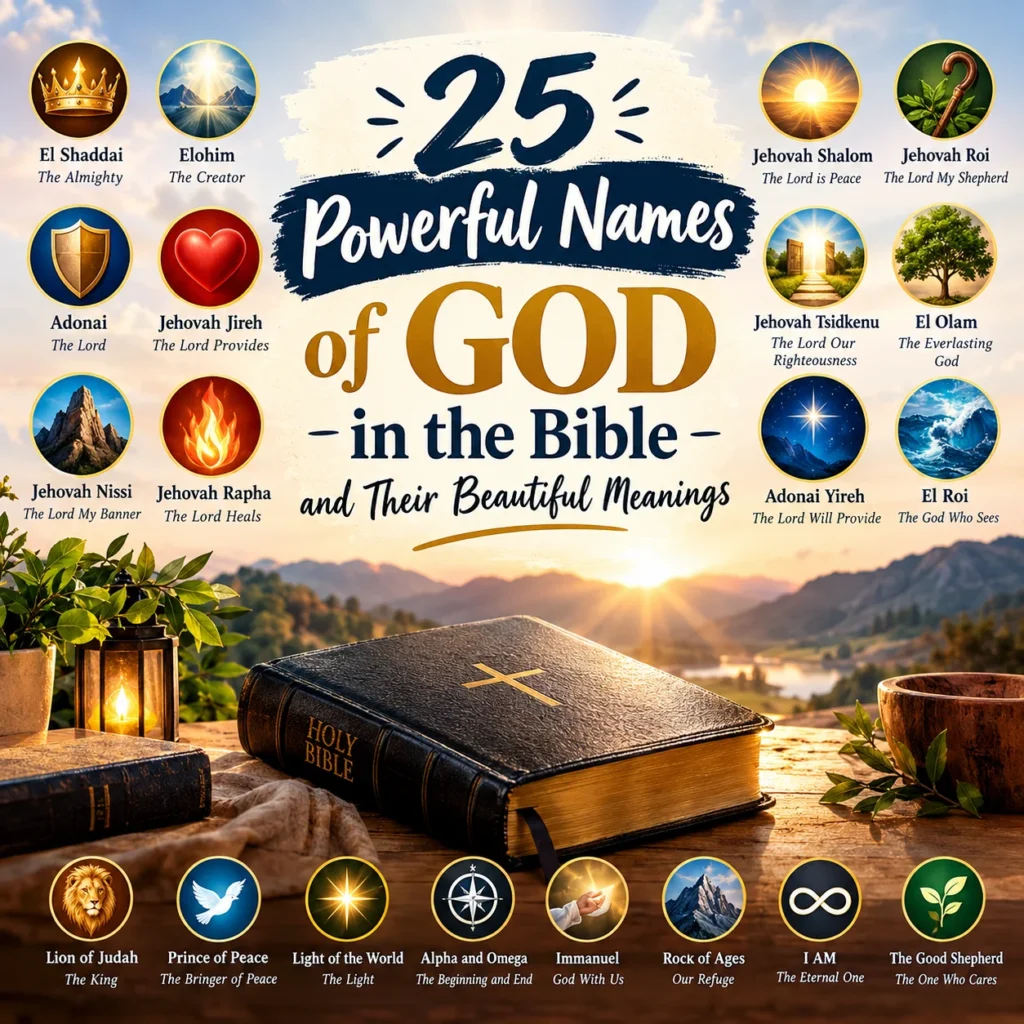
The Bible reveals God through many names, titles, and descriptions, each offering readers a deeper understanding of His character and relationship with humanity. Some names highlight His power as Creator, while others express His mercy, provision, peace, faithfulness, and presence.
For anyone studying Scripture, exploring the names of God in the Bible can make familiar passages feel more meaningful. A name that appears in a story about Abraham may reveal something different from a title used by David in a psalm or by Isaiah in a prophecy.
These names are not simply words to memorise. They connect to real biblical events, prayers, promises, and moments of uncertainty. They also reflect the language and culture of the ancient world in which the Bible was written.
This guide explores 25 important biblical names and titles, explains their commonly understood meanings, and provides Scripture references for further reading. It also clarifies common misunderstandings and offers practical ways to study these names in everyday Bible reading.
Why Are the Names of God Important in the Bible?
In biblical times, names often carried meanings connected to a person’s identity, family, character, or circumstances. The names and titles used for God similarly communicate important ideas about how Scripture presents Him.
For example, Genesis 1:1 introduces God as Creator, while Exodus 3 describes His revelation to Moses before the Israelites’ deliverance from Egypt. Psalm 23 presents the Lord through the comforting image of a shepherd.
Studying these descriptions helps readers recognise different themes throughout Scripture.
The names of God in the Bible can be grouped into several broad categories:
- Primary names: Such as Elohim and Yahweh.
- Names and titles describing divine attributes: Such as El Shaddai and El Elyon.
- Compound names: Such as Yahweh Jireh and Yahweh Shalom.
- Relational titles and descriptions: Such as Father, Shepherd, King, and Redeemer.
Not every biblical designation is technically a personal name. Some are titles, metaphors, or descriptions of God’s character. Understanding this distinction helps readers interpret the passages more accurately. Source: Bible Gateway’s Encyclopedia of the Bible
25 Names of God in the Bible and Their Meanings
1. Elohim — God, the Creator
Meaning: God; commonly associated with divine power and majesty.
Bible reference: Genesis 1:1
Elohim appears in the opening verse of Genesis, where God creates the heavens and the earth. Its use introduces the biblical picture of God as the source of creation and the One who brings order to the universe.
The word has a plural form in Hebrew, but when Elohim refers to Israel’s God, it commonly appears with singular grammatical agreement. Its form should not be used by itself as proof of a particular theological doctrine.
For readers, the opening of Genesis establishes an important theme: the created world is not presented as independent of its Creator.
2. Yahweh — The LORD
Meaning: God’s personal name in the Hebrew Bible; its precise etymological explanation remains debated.
Bible reference: Exodus 3:14–15
Yahweh is represented by the four Hebrew consonants YHWH. Many English Bible translations print this name as LORD, using capital letters to distinguish it from the ordinary title “Lord.”
In Exodus 3, God speaks to Moses from the burning bush and commissions him to lead the Israelites out of Egypt. The passage connects God’s name with His self-revelation and His commitment to His people.
This name is particularly important for understanding God’s covenant relationship with Israel. It reminds readers that the biblical story presents God not merely as an abstract power, but as one who acts within history.
3. Adonai — Lord or Master
Meaning: Lord, Master, or Sovereign.
Bible reference: Genesis 15:2
Adonai expresses authority, honour, and the relationship between a ruler and those under that authority. It is often translated as “Lord” in English.
In Genesis 15, Abram addresses God while expressing his concerns about the future. His words show that faith and honest questions can appear together in the same conversation.
The title encourages readers to consider what it means to trust God’s authority even when the next step is not yet clear.
4. El Shaddai — God Almighty
Meaning: Traditionally translated as God Almighty; the exact origin and nuance of Shaddai are debated.
Bible reference: Genesis 17:1
God uses this designation when appearing to Abram and establishing His covenant promises. The setting includes promises about descendants and the future of Abram’s family.
The name is often associated with divine might and sufficiency. Its significance becomes clearer when read within the story of a couple who have waited a long time for the promised child.
El Shaddai reminds readers that biblical promises are frequently presented against circumstances that appear difficult or impossible.
5. El Elyon — God Most High
Meaning: God Most High.
Bible reference: Genesis 14:18–22
El Elyon appears in the account of Melchizedek, king of Salem and priest of God Most High. He blesses Abram and identifies God as the maker of heaven and earth.
This title emphasises God’s supremacy. Human rulers may possess wealth, land, and military power, but the biblical passage directs attention towards the authority of the Creator above them.
Psalm 9:2 also celebrates God as Most High, connecting the title with praise and confidence in His sovereignty.
6. El Olam — The Everlasting God
Meaning: The Everlasting God or God of eternity.
Bible reference: Genesis 21:33
After making an agreement with Abimelech, Abraham plants a tamarisk tree at Beersheba and calls upon the name of the LORD, the Everlasting God.
The name highlights God’s enduring nature in contrast with the temporary character of human life and circumstances.
For someone experiencing change, uncertainty, or disappointment, this passage offers a theme worth reflecting on: biblical faith is rooted in the belief that God is not limited by the shortness of human time.
7. El Roi — The God Who Sees Me
Meaning: Commonly rendered “the God who sees me.”
Bible reference: Genesis 16:13
El Roi is associated with Hagar, who encounters the angel of the LORD after fleeing a painful situation involving Sarai and Abram.
Hagar’s story is especially significant because she is a vulnerable person whose distress takes place within a complicated household. Her encounter gives the passage a powerful theme of being seen in circumstances where one might feel overlooked.
This name is a reminder that biblical narratives include people on the margins, not only kings, patriarchs, and prominent leaders.
8. Yahweh Jireh — The LORD Will Provide
Meaning: Traditionally translated “The LORD will provide.”
Bible reference: Genesis 22:14
This name appears in the account of Abraham and Isaac on Mount Moriah. At a critical moment, God provides a ram for the sacrifice.
The surrounding story is essential to understanding the name. It is connected to a specific event and Abraham’s naming of the place after the provision he experiences.
Readers often associate Yahweh Jireh with trusting God during times of need. However, the passage should not be treated as a guarantee that every personal wish or financial goal will be fulfilled exactly as expected.
9. Yahweh Rapha — The LORD Who Heals
Meaning: The LORD who heals.
Bible reference: Exodus 15:26
After the Israelites leave Egypt, they reach the waters of Marah, where the water is bitter. The narrative describes God’s instruction and introduces a statement about His healing power.
This title is associated with restoration and well-being. Healing in biblical literature can involve physical recovery, but the broader theme of restoration also appears in spiritual and communal contexts.
The passage encourages readers to take healing seriously without assuming that illness or suffering automatically indicates a lack of faith.
10. Yahweh Nissi — The LORD Is My Banner
Meaning: The LORD is my banner.
Bible reference: Exodus 17:15
Following Israel’s battle against Amalek, Moses builds an altar and gives it this name.
In the ancient world, a banner could represent a group, a rallying point, or a sign of identity. The image therefore connects the name with the people’s recognition of God’s role in the story.
For contemporary readers, Yahweh Nissi can serve as a reminder to consider the source of their confidence rather than treating personal strength as the only explanation for success.
11. Yahweh Shalom — The LORD Is Peace
Meaning: The LORD is peace.
Bible reference: Judges 6:24
Gideon builds an altar after an encounter with the angel of the LORD. The story takes place during a period when Israel faces oppression by the Midianites.
The name is meaningful because Gideon is not living through a peaceful or secure period. The surrounding narrative includes fear, uncertainty, and a difficult calling.
Yahweh Shalom therefore offers a deeper picture of peace than the absence of problems. It points readers towards trust and reassurance even when circumstances remain unsettled.
12. Yahweh Tsidkenu — The LORD Is Our Righteousness
Meaning: The LORD is our righteousness.
Bible reference: Jeremiah 23:5–6
Jeremiah uses this designation in a prophecy about a righteous king from David’s line. The passage contrasts the promised ruler with failures among Israel’s leaders.
The name connects righteousness with God’s purposes for just leadership and the restoration of His people.
It also reminds readers that biblical righteousness is not simply a matter of appearing respectable. The prophetic context includes justice, responsible leadership, and the welfare of the community.
13. Yahweh Rohi — The LORD Is My Shepherd
Meaning: The LORD is my shepherd.
Bible reference: Psalm 23:1
Psalm 23 opens with the well-known image of the Lord as a shepherd. The Hebrew expression is often transliterated as Yahweh Rohi or Yahweh Raah, although forms vary according to transliteration conventions.
A shepherd guides, feeds, and protects a flock. In the psalm, this image develops into a picture of provision, guidance through danger, and hospitality.
The metaphor is powerful because it describes a relationship rather than merely an attribute. God is presented as one who leads and cares for His people.
14. Yahweh Sabaoth — The LORD of Hosts
Meaning: The LORD of Hosts or the LORD of heavenly armies.
Bible reference: 1 Samuel 1:3
The expression “hosts” refers to armies or organised forces and, in biblical contexts, can evoke heavenly powers as well.
The title appears in the account of Hannah’s family and her visits to worship at Shiloh. It also appears frequently in prophetic literature.
Its significance extends beyond warfare. It portrays God as possessing authority over powers greater than any individual or earthly ruler can command.
15. Yahweh Shammah — The LORD Is There
Meaning: The LORD is there.
Bible reference: Ezekiel 48:35
This name appears at the conclusion of Ezekiel’s vision of a restored city. The final name given to the city expresses the significance of God’s presence.
The context matters: Ezekiel’s visions emerge against the background of exile and the destruction of Jerusalem. The promise of a restored place represents hope after loss.
Yahweh Shammah speaks to the biblical theme that restoration involves more than rebuilding structures. God’s presence is central to the vision.
16. Yahweh Mekaddishkem — The LORD Who Sanctifies You
Meaning: The LORD who makes you holy or sets you apart.
Bible reference: Exodus 31:13
This expression appears in instructions concerning the Sabbath and Israel’s covenant relationship with God.
Sanctification refers to being made holy or set apart for a sacred purpose. In this context, the Sabbath becomes a sign of the relationship between God and Israel.
The name helps readers see holiness as more than a private feeling. It is also connected to practices, commitments, and the identity of a community.
17. Yahweh El Gemolah — The LORD Who Repays
Meaning: Commonly rendered the LORD of recompense or the LORD who repays.
Bible reference: Jeremiah 51:56
This expression is connected with Jeremiah’s prophecy against Babylon. The chapter speaks about judgment and the consequences of violence and oppression.
The name should be read within its prophetic setting rather than treated as a promise that every personal grievance will receive immediate public vindication.
Its broader theme concerns divine justice and accountability. It encourages readers to take wrongdoing seriously while resisting the temptation to use Scripture to justify personal revenge.
18. Yahweh Elohim — The LORD God
Meaning: The LORD God.
Bible reference: Genesis 2:4
This combined designation appears in the account of creation and the beginning of the human story in Genesis 2.
It brings together the personal divine name, YHWH, and Elohim, the Hebrew term commonly translated as God.
The expression links the Creator introduced in Genesis with the God who forms the human being and establishes a relationship with creation. It also helps readers recognise how biblical writers combine names and titles for emphasis.
19. Ehyeh Asher Ehyeh — I AM WHO I AM
Meaning: Commonly translated “I AM WHO I AM,” with other possible renderings depending on interpretation.
Bible reference: Exodus 3:14
When Moses asks about God’s name, the biblical account records this Hebrew expression. It is closely related to the revelation of the name YHWH in the following verse.
The phrase has generated extensive theological discussion because its meaning can be understood in more than one way. It is often associated with God’s existence, freedom, and self-disclosure.
For readers, the central point is the connection between God’s identity and the mission given to Moses: the God who sends him is not an unknown or powerless figure.
20. Yah — The Short Form of Yahweh
Meaning: A shortened form of the divine name YHWH.
Bible reference: Psalm 68:4
The short form Yah appears in biblical poetry and worship. It is also familiar through the Hebrew expression Hallelujah, commonly understood as “Praise Yah” or “Praise the LORD.”
Psalm 68 uses poetic language to celebrate God’s greatness and victory.
This shorter form illustrates how the divine name appears in different literary settings, particularly songs and expressions of praise.
21. Father — A Relational Title for God
Meaning: Father; a description of relationship, care, authority, and belonging.
Bible reference: Matthew 6:9
In the Lord’s Prayer, Jesus teaches His disciples to address God as “Our Father in heaven.”
The title presents a relational way of approaching God. It appears in a prayer that combines reverence, a desire for God’s kingdom, daily dependence, forgiveness, and deliverance from evil.
The image of fatherhood may carry different emotional associations for different readers. In biblical teaching, the title directs attention towards God’s character rather than suggesting that every human father’s behaviour reflects Him accurately.
22. King — The Sovereign Ruler
Meaning: King or supreme ruler.
Bible reference: Psalm 47:7
Psalm 47 celebrates God as King over all the earth. Its language uses the familiar political image of kingship to express divine authority.
Ancient Israel knew the influence of earthly monarchs, including their achievements and failures. Biblical descriptions of God as King place ultimate authority beyond human political power.
The title encourages readers to consider justice, humility, and accountability when thinking about leadership.
23. Redeemer — The One Who Rescues and Restores
Meaning: Redeemer, deliverer, or one who restores what has been lost.
Bible reference: Isaiah 44:6
Isaiah frequently uses the language of redemption while addressing Israel’s hope for restoration. In ancient Israel, redemption could involve the recovery of family property, protection of a relative, or release from a difficult condition.
In prophetic writing, the concept expands into God’s deliverance of His people.
The title is especially meaningful in passages where people feel that their history has reached a dead end. Redemption introduces the possibility of restoration without pretending that suffering never occurred.
24. Rock — A Picture of Strength and Refuge
Meaning: Rock, symbolising stability, protection, and reliability.
Bible reference: Deuteronomy 32:4
The Song of Moses describes God as the Rock whose work is perfect and whose ways are just.
Unlike some of the Hebrew expressions discussed above, “Rock” is a metaphorical description rather than a conventional personal name. Nevertheless, it communicates a central biblical image of divine faithfulness.
A rock provides a picture of something firm amid changing conditions. In Scripture, the metaphor often appears in praise, reflection, and declarations of trust.
25. Immanuel — God With Us
Meaning: God with us.
Bible reference: Isaiah 7:14; Matthew 1:22–23
Immanuel is a Hebrew name that becomes especially significant in Christian interpretation through Matthew’s account of Jesus’ birth.
In Isaiah, the name appears within a prophecy addressed to a particular historical situation. Matthew later cites the passage and applies it to the birth of Jesus.
Christians understand this connection as part of the biblical presentation of Jesus and God’s presence among humanity. Reading both passages in context helps readers appreciate the relationship between the Old and New Testaments without ignoring their different historical settings.
Names of God in the Bible: Quick Reference Table
The following table provides a convenient summary of the names and titles covered in this guide.
| Name or title | Common meaning | Bible reference |
|---|---|---|
| Elohim | God, Creator | Genesis 1:1 |
| Yahweh | The LORD; divine personal name | Exodus 3:15 |
| Adonai | Lord or Master | Genesis 15:2 |
| El Shaddai | God Almighty | Genesis 17:1 |
| El Elyon | God Most High | Genesis 14:18–22 |
| El Olam | Everlasting God | Genesis 21:33 |
| El Roi | God who sees me | Genesis 16:13 |
| Yahweh Jireh | The LORD will provide | Genesis 22:14 |
| Yahweh Rapha | The LORD who heals | Exodus 15:26 |
| Yahweh Nissi | The LORD is my banner | Exodus 17:15 |
| Yahweh Shalom | The LORD is peace | Judges 6:24 |
| Yahweh Tsidkenu | The LORD our righteousness | Jeremiah 23:6 |
| Yahweh Rohi | The LORD is my shepherd | Psalm 23:1 |
| Yahweh Sabaoth | The LORD of Hosts | 1 Samuel 1:3 |
| Yahweh Shammah | The LORD is there | Ezekiel 48:35 |
| Yahweh Mekaddishkem | The LORD who sanctifies | Exodus 31:13 |
| Yahweh El Gemolah | The LORD of recompense | Jeremiah 51:56 |
| Yahweh Elohim | The LORD God | Genesis 2:4 |
| Ehyeh Asher Ehyeh | I AM WHO I AM | Exodus 3:14 |
| Yah | Short form of Yahweh | Psalm 68:4 |
| Father | Relational title | Matthew 6:9 |
| King | Sovereign ruler | Psalm 47:7 |
| Redeemer | Rescuer and restorer | Isaiah 44:6 |
| Rock | Strength and refuge | Deuteronomy 32:4 |
| Immanuel | God with us | Isaiah 7:14; Matthew 1:23 |
The meanings in this table are common English renderings, not a claim that every Hebrew word has only one possible translation. Some compound forms vary across reference works and Bible translations.
How the Names of God Reflect His Character
The most useful way to study the names of God in the Bible is to connect each one with the story or passage where it appears.
Names connected with power and authority
Elohim, El Shaddai, El Elyon, and King emphasise creation, sovereignty, and divine authority. They appear in passages that consider God’s relationship with the world, nations, and human history.
These titles can be especially helpful when studying Genesis, the Psalms, and prophetic books.
Names connected with care and provision
El Roi, Yahweh Jireh, Yahweh Rohi, and Father highlight themes of seeing, providing, guiding, and relating to people.
Their surrounding stories make these descriptions more than abstract definitions. Hagar’s distress, Abraham’s test, David’s poetry, and Jesus’ teaching each provide a distinct context.
Names connected with peace and restoration
Yahweh Shalom, Yahweh Rapha, Yahweh Tsidkenu, Redeemer, and Immanuel point towards themes of healing, justice, restoration, and presence.
These descriptions can be particularly meaningful in personal reflection, provided the original context is not overlooked.
The different names do not necessarily describe separate gods or competing divine identities. In their biblical settings, they are names, titles, and images used to communicate different aspects of God’s identity and actions.
Common Misconceptions About the Names of God
Misconception 1: Every name is a direct promise about personal circumstances
A reader might encounter Yahweh Jireh and conclude that God will provide a specific job, income, or possession. Another might read Yahweh Rapha and assume that illness must immediately disappear if enough faith is present.
Such conclusions go beyond what the names alone establish. Each expression belongs to a passage with its own events, audience, and message.
A better approach is to ask what the passage says about God, what happened in the original story, and how its broader themes might inform faith today.
Misconception 2: Every name has one exact English translation
Ancient Hebrew expressions do not always map neatly onto a single English phrase. Transliteration systems also differ, especially when Hebrew consonants and vowels are represented in the Latin alphabet.
For example, readers may encounter Yahweh Jireh, Jehovah Jireh, or other spellings of the same expression. These differences do not necessarily indicate different biblical names.
Reliable interpretation depends on examining the original passage, comparing trustworthy translations, and recognising where scholars disagree.
How to Study the Names of God in the Bible
Readers do not need advanced knowledge of Hebrew to begin exploring biblical names. A simple, consistent method can make each study more meaningful.
Step 1: Read the entire passage
Start with the verse where the name appears, then read the surrounding paragraphs or chapter. This helps establish who is speaking, what has happened, and why the designation matters.
Step 2: Write down the meaning and reference
Record the name, its commonly accepted meaning, and the relevant Bible passage. Keep uncertain or debated translations clearly identified.
Step 3: Identify the central theme
Ask whether the passage emphasises provision, authority, faithfulness, justice, peace, or another characteristic.
Avoid assuming that a name communicates every attribute of God equally in every context.
Step 4: Compare two Bible translations
A comparison may reveal different ways of rendering a Hebrew expression. Study notes or a Bible dictionary can help explain why those differences exist.
Step 5: Reflect and apply carefully
Consider how the passage might shape prayer, decisions, relationships, or personal attitudes. Application should grow from the passage’s message rather than from an isolated definition.
For example, studying Yahweh Shalom alongside Judges 6 can encourage reflection on trust during uncertainty. It does not require the reader to pretend that a difficult situation is already resolved.
Read more: 7 Powerful Reasons Why Name Numerology Is Booming.
Frequently Asked Questions About the Names of God in the Bible
How many names of God are there in the Bible?
There is no universally agreed total. Some lists count only major Hebrew names, while others include compound expressions, titles, metaphors, and New Testament descriptions.
The number therefore depends on the criteria used to define a name. A list of 25 important names and titles is a useful starting point, not an exhaustive count.
What is the first name of God in the Bible?
Elohim is the designation used for God in Genesis 1:1, the opening verse of the Bible. However, the question of God’s first name can mean different things: the first designation in the text, the first occurrence of the personal name YHWH, or the first name revealed in a particular narrative.
These distinctions matter when studying the biblical text carefully.
What does Yahweh mean?
Yahweh is the conventional scholarly vocalisation of the Hebrew divine name written YHWH. Its precise etymology is debated, although it is closely associated with God’s revelation to Moses in Exodus 3:14–15.
Many English translations represent this name as LORD in capital letters.
Are Yahweh and Jehovah the same name?
Yahweh and Jehovah are traditional renderings associated with the same four Hebrew consonants, YHWH. Their forms reflect different historical approaches to representing the divine name in other languages.
Readers may encounter either form depending on their Bible translation and religious tradition.
Which name of God means God is with us?
Immanuel means “God with us.” It appears in Isaiah 7:14 and is quoted in Matthew 1:22–23 in the Christian account of Jesus’ birth.
Which name means the LORD will provide?
Yahweh Jireh is traditionally translated “The LORD will provide.” It is associated with Genesis 22:14 and Abraham’s naming of the place following God’s provision of a ram.
Are the names of God the same in the Old and New Testaments?
The languages and forms differ. The Old Testament, primarily written in Hebrew with some Aramaic, uses names such as Yahweh and Elohim. The New Testament, written in Greek, commonly uses Theos for God and Kyrios for Lord, alongside relational titles such as Father.
Christian readers understand the two Testaments as connected, while also recognising their distinct historical and literary settings.
Conclusion: Discover the Meaning Behind God’s Names
The names of God in the Bible provide a rich way to explore Scripture. Elohim highlights God as Creator, El Roi recalls the story of a woman who felt seen in distress, Yahweh Shalom connects God’s presence with peace, and Immanuel expresses the theme of God being with humanity.
Their significance becomes clearer when readers study each name within its original passage instead of treating it as an isolated slogan or a guaranteed formula for personal success.
A practical next step is to choose one name, read its biblical context, write down its meaning, and reflect on the passage’s central message. Over time, this simple habit can deepen biblical understanding and make familiar stories more engaging.
Readers can begin with Genesis 16:13, Exodus 3:14–15, Psalm 23, and Judges 6:24. Each passage offers a different perspective on the character and presence of God.